Crackerjack in the Kitchen

eb991025b477fc57a3b24206f6b28192.jpg

By Ed Staskus

   “I see you’ve made it back,” Michelle said. She was sporting retro eyeglasses and handcrafted rings on nearly every finger of every hand. Waiting tables, delivering three, four, and five plates at a time, is all hands on deck kind of work.

   “I want to try the pad Thai this time, after seeing the folks next to us digging into it the last time we were here,” Vera said.

   “That’s one of Emily’s best, definitely,” Michelle said. “Would you like to start with a drink?” She was one of three servers on the floor the mid-September evening Frank and Vera Glass were there for dinner. It was busy but nobody had to wait long for liquids and solids. The place was The Mill in New Glasgow on Prince Edward Island.

   “What is a good mixed drink?” Vera asked, running her eyes up and down the menu.

   “Everything is good, but Kim can mix up anything if we don’t have it on the list.”

   “What is Straight Shine?”

   “Shine.”

   “Like moonshine?”

   “Just like that. It’s our island-made moonshine.”

   “Like Ole Smoky in a mason jar?” Frank asked.

   “Not the same, it’s more like a margarita,” Michelle said.

   “That’s a step in the right direction.”

   “My God, I should moonshine,” Vera said. “My grandfather used to make his own vodka at home. All his friends from Lithuania, who escaped during the war, would come over on Sunday afternoons after church, drinking the rest of the day, yakking it up and singing their old country songs all night. I’ll try it, for sure”

   “Not for me,” Frank said, “I’ll have a pint, something IPA.”

   The Mill is in a two-story Dutch Colonial-like blue building built in 1896. It served as a community center and later as a courthouse, among its many incarnations. It was converted to a restaurant in the 1990s by the Larkin’s, nearby poultry farmers who are the largest turkey growers in the province.

   “We used to have a guy in shipping where I worked, in the warehouse, from West Virginia, who brought back moonshine every time he went home for a visit,” Frank said. Vera sipped her Straight Shine. “He always said you could tell it was good if you put a match to it and the flame burned blue. That meant it was good to go and wouldn’t make you go blind.”

   Michelle walked up and lit the tea candle on their table.

   “How is it?”

   “It looks good to me,” Vera said. “What I mean is, it tastes good.”

   When the Larkin’s transitioned out of the dining room business, The Mill stayed where it was when chef Emily Wells took over, putting her fusion-style stamp on the dining room. Diners soon put their stamp of approval on the fare.

   Vera ordered the stir-fried garlic ginger cilantro rice noodle fettucine pad Thai with lobster and Frank ordered the special, which was curry sweet potato soup, baby back ribs with mac and cheese, and dessert. It was East meets West meets Italy. Fusion cooking is the art of mixing ingredients and preparation styles from different cultures into a distinctive plate of tastiness.

   The window Frank and Vera were sitting at had gone dark by the time they finished their dinners, although Vera was still coming around the bend. She was a slow eater and her plate had been stacked. A quarter-moon in a cloudless sky reflected a milky light on the Clyde River below them in the hollow. Frank leaned back in his chair as Vera lifted a final forkful to her mouth.

   “Since we both ordered something new to us, why don’t we try something new for dessert, too?” Frank said.

   They had eaten at The Mill several times and usually ordered coffee and carrot cake after dinner, since the carrot cake was just about the best they had eaten anywhere.

   “It’s better than my mom’s, and she’s a pro,” Vera said.

   Vera’s mother was a freelance pastry chef in Cleveland, Ohio, providing sundry restaurants with sweet treats. During the holidays she made website-ordered Russian Napoleon cakes, shipping them frozen solid all around the country by Fed-Ex next-day air.

   “How about the chocolate cake that couple from Boston told us about?” Vera asked.

   “When we’re here we drive around the island,” the husband from Boston said. “We’ve eaten at a lot of restaurants but overall this is our absolute favorite. What’s so great about it? The unique combination of flavors and menu options, for one, and there’s not a deep fryer in the kitchen, for another thing. They’re dedicated to local sourcing, which means super fresh food and vegetables. Make sure to try the chocolate cake even if you’re full. It melts in your mouth.”

   He added that the portion was large, too, enough to share. Unlike some restaurants with a glowing reputation on Prince Edward Island, in the meantime serving prison camp portions at penthouse prices, The Mill gets it done with a square deal, even though it has as much, if not more, in the culinary arts to crow about.

   “Do you bake the chocolate cake here?” Vera asked.

   “Our baker does,” Michelle said.

   They ordered  a slice of the chocolate cake and two coffees. Michelle stopped at their table. She asked them how they liked the cake.

   “It’s totally delicious, the dark chocolate, if you want to let the baker know,” Frank said. A few minutes later a strapping youngster with disheveled hair walked up to their table. She said she was the baker and her name was Anna. She looked like she was maybe a sweet sixteen teenager.

   “You made this?” Frank asked, pointing to the half-eaten slice of cake he was sharing with his wife.

   “Yeah,” Anna said, wiping her hands on her apron.

   “Do you make the carrot cake, too?”

   “Yeah.”

   “This cake is what chocolate cake should taste like, up-to-the-minute,” “era said. “They can be boring, the same thing over and over again. This is definitely a bomb cake, in more ways than one.”

   “You seem awfully young to be making something this good,”  Frank said.

   “Yeah,” Anna said, shrugging and smiling.

   “How old are you?”

   ““I was 15 years old when I first started cooking here two years ago.. I came in to work one day, I was bussing tables, and my boss said, you’re scaring everybody out there. You have to go into the kitchen. From that point on I’ve worked in the kitchen.”

   “Scaring everybody?” 

   “Yeah, they said my personality was too big.”

   “Too big?” 

   “I was just barely fifteen. How scary could I be? I guess I can be scary sometimes. Nothing’s really changed.”

   “I told her when she worked out front that she was scaring the customers with her huge personality,” Kim, the mixologist, said “Now that she’s in the kitchen she can still be scary, I’ll teel you. She’s come up with nicknames for all of us. We won’t talk about that, though. It can get gross.”

   “What did you guys eat?” Anna asked..

   “She had the Thai and I had the special,” Frank said. “We often have the big seafood chowder bowl, the unofficial one.” 

   “Ahhh,” Anna said.

   “I’ve heard you have a name for it in the kitchen.”

   “We have a nickname for it.”

   “That would be Big Ass Bowl?”

   “Yeah.”

   “I always taste orange in the soup,” Vera said.

   “Yeah, there are orange peels, marinated, and bay leaves, that we take out right before service. We make our own fish broth.”

   The restaurant, brainchild of Emily Wells, who was named one of Canada’s top chefs by the Matador Network in 2016, serves local food made with global flair. She works in an adaptive vein, adapting her recipes to what’s in place and on time. “We’re buying local lettuce, local tomatoes,” Emily said. “A huge chunk of it is seafood since it’s seafood season.” A graduate of the first class at the Culinary Institute of Canada, she cut her teeth in kitchens in Ontario and later made a name for herself at The Dunes in Brackley Beach.

   “I’ve been at it for thirty-five years,” she said.

   “Oh, I’ve got mussels on the stove, back in a minute,” Anna said, striding out of the dining room.

   “I thought Emily was making the desserts, or they were buying them from some high-end bakery,” Vera said.

   “If that teenager is the pastry chef, all I can say is, she’s totally up to speed,”  Frank said.

   “Do you make all the desserts?” Vera asked when Anna came back to their table.

   “Yeah, I’m a line cook and the baker.”

   “My mother is a pastry chef. You’re darned good.”

   “How did you learn to bake so well?” Frank asked.

   “Emily taught me. I‘m a quick study. I learned a lot from my grandmother, too I used to spend all my time with her when I was a kid. She taught me how to pickle and bake.”

   Not everybody is good with pastry, not by any means. Not even celebrity chefs. “I make no bones about it,” says Michael Symon, chef, author, and restaurateur. “I have no understanding of pastry whatsoever.”

   “Honestly, I hate to say this,” Anna said, “but my aunt makes an even better carrot cake than I do.”

   “You’re early on to be nearly as good as your aunt,” Frank said.

   “Most of our staff is young,” Anna said. “Everybody in the kitchen is under 20, except Andrea and Emily. We have a 19-year-old, another 17-year-old, and a 13-year-old, who I   is my sister. Luke, our other prep, has three younger brothers who work here.”

   “It’s like the family line on the line,” Frank said..

   If you are under sixteen in the province of Prince Edward Island and want to work, you must have permission from your parents, must work only between 7 AM and 11 PM, and not work in an environment that is harmful to your health, safety, or moral development, among other things. If you are over sixteen, those limits don’t apply.

   Sometimes known as the Million-Acre Farm, farming is king on the island. Farming for a living is hard work. You probably don’t need a gym membership. There are some advantages. You are your own boss, you can go to work in boots and a t-shirt, and you eat like a king.

   “I started as a dishwasher,” Anna said.

   Working the dish pit means long hours on your feet, getting wet a lot, and ending the day smelling like food and soap. It’s not markedly different than farming, except farming is at the head of the line and washing dishes is at the end of the line.

   “The kids are great,” Kim said. “Ours is a teaching kitchen, so they get an education, and get paid. They all have a great work ethic. The little hostess, she’s fifteen, a crackerjack like Anna. It’s good to see that they want to work. I’ve worked in other places, and it’s like pulling teeth, all standing around. Here, they’re eager to learn and do.”

   “A lot of people, their idea of baking is buying a ready-made mix and throwing in an egg,” Vera said. “I make carrot cake at home, but it’s just carrots and stuff. One of our cats likes a piece now and then. Yours is both simple and complex. It’s subtle, really fine,”

   “The main spices we use are ginger, cloves, and cinnamon, and a bit of all-spice, and that’s about it.”

   “The cake isn’t heavy, which is what I like.”

   “There’s pineapple in it, too.”

   “The frosting is terrific.”

   “I was supposed to whip up more frosting yesterday, but I couldn’t come to work,” Anna said. “I decided my cat must have died.”

   “Oh, my gosh, that’s too bad!”  Vera said. “What happened to make you decide that?”

   “She was an outdoor cat. I had her since I was six, I came home one day and asked, where’s my cat, but nobody had seen her for days. It’s been a month now. I sat outside yesterday in my lawn chair until it got dark, hoping she would come back but she never did. I’m pretty sure she got eaten by a coyote.”

   After paying the bill, Frank and Vera lingered outside at the rail on the front deck. The band that had been playing in the upstairs loft was in the parking lot, still hooting it up. The night air was damp but brisk. The moon hovered in the inky sky. Across the street lights glowed over the bay doors of the New Glasgow Volunteer Fire Department.

   “That girl might be one of the best 17-year-old pastry chefs no one has ever heard of,” ” Frank said.

   “Between the known and the unknown, what else is there?” Vera said.

   “That moonshine seems to have gone to your head,” Frank said.

   “Ha, ha, ha. Anyway, she’s got a big smile, big energy, and some big cake talent. Somebody will hear about her, sooner or later.”

    There’s always a ‘Surprise Inside’ every box of Cracker Jack, Frank thought.

   They walked to the end of the deck leading to the side lot. Fluorescent lights blazed in the windows of the kitchen. Dishes clattered in sinks, the kitchen staff having a gab fest as they cleaned up. They heard high-spirited laughter, which followed them down the steps and a stretch of parking lot gravel to their car. A red fox chasing a brown rabbit ran past them into the bushes. 

   “You know how they say you are what you eat,” Frank said.

   “Of course.”

   “This is as good a place to be what you eat as any.”

Ed Staskus posts monthly on 147 Stanley Street  http://www.147stanleystreet.com, Made in Cleveland http://www.clevelandohiodaybook.com, Down East http://www.redroadpei.com, and Lithuanian Journal http://www.lithuanianjournal.com. To get the site’s monthly feature in your in-box click on “Follow.”

“Cross Walk” by Ed Staskus

Late summer, New York City, 1956. Big city streets full of menace. A high profile contract killing in the works. A private eye working out of Hell’s Kitchen scares up the shadows.

Available on Amazon: https://www.amazon.com/dp/B0CRPSFPKP

A Crying of Lot 49 Publication
Head Over Heels

By Ed Staskus

   It was wetter than not wet the front end of summer and too muddy to ride the single tracks in the Rocky River valley. It rained on nine days the first two weeks of July. Instead of the single tracks, I rode my Specialized on the all-purpose trail and left my Schwinn hanging in the garage. The Schwinn was outfitted for dirt, with front shocks and a low stem. The Specialized was outfitted with road tires, knobby on the outside and smooth rolling on the flat side, making for better riding on asphalt.

   It made for even faster riding down Hogsback Lane, which is the entryway off Riverside Dr. into the valley. It is laid down on a steep shale hill. It’s about a half mile to the bottom. When the shale slumps and slides, the two-lane surface crumbles, and it’s then prudent to keep your eyes fixed on the road. Hunched over the handlebars I could hit 40 MPH downhill, no problem, unless I feathered the brakes, which I usually did, lessening the chances of flying over the handlebars. That would have been a grave misadventure.

   I rode alone most of the time, especially that summer because my brother Rick, with whom I occasionally rode, was getting married. He said he didn’t have much time to get on his bike anymore. “I’ve got a lot going on,” he explained. He had been married once before, but it only lasted two months. He wanted to make his next marriage work out better.

   “I don’t want him racing that crazy hill and crashing,” his fiancée Amy said. She didn’t want a train wreck walking down the aisle with her. She and Rick had met earlier in the year on a blind date. One whirlwind after another led to the one-way street they were on.

   “You be careful, too” my wife said watching me hitching up in the backyard.”

   The summer of 1995 was hot, in the high 80s when it wasn’t in the high 90s. I could have ridden the single tracks, since they had dried up going into August, but I stayed on the all-purpose trails. Towards the end of one week, after getting home from work, I rode twelve miles out, almost all the way to Berea. It was on the way back that I passed a man wearing a red helmet. Inside a few minutes the red helmet was behind me, drafting, but when I slowed down for a car at the crossroads to the entrance of Little Met, he slipped past me when the car paused to let us go by. The trail went up a long hill. I finally caught up at the top.

   He tucked in behind me and we rode to where the trail zigzagged through some curves  where he got sloppy. He tried to pass two women on roller blades, except on an inside-out curve, and when another bike came up on the other side, he had to slalom wide onto the grass. He had to loop back. I waited for him to catch up.

   “That was a good pace,” he said before I peeled away to go home, while he kept going his own way. Pedaling up Hogsback Lane is a long slog, which is what I did, shifting into lower gears. By the time I got close to the crest I was on the verge of stalling. When I made it to flat land I sucked air.

   The next weekend Rick had an appointment for a haircut at Planet 10, on W. 9th St., and wanted to ride there. We rode through Ohio City to Church St. He pointed out an old church whose rectory had been converted into a recording studio.“That’s where we’re having our reception,” he said. Amy was a sometime actress and sometime singer. She had the looks and the voice. She made a living doing nails, since nailing roles in Cleveland wasn’t a paying proposition. Her sometime showbiz was her drinking money.

   Rick was Catholic and of Lithuanian stock, like me, but they were getting married in an Episcopalian church instead of the ethnic church where we had grown up. Even though Amy was an atheist, her well-off grandmother wasn’t and wanted her to be married in a house of God. Amy didn’t like the old Lithuanian church in North Collinwood, so it was going to be someplace else.

   We went south on W. 25th St., crossed the bridge to Jacobs Field, and rode to the Warehouse District. The bride-to-be was still all right with Rick riding city streets, but not any farther into the near east side, which I often did, to Cleveland Hts. through the ghetto along Cedar Rd. She quashed that by stamping her foot. “I don’t want him getting killed by any porch monkey,” she said.

   Rick pushed his bike into Planet 10’s lobby and I rode away. After zigzagging around downtown, on my way home, stopping at a narrow strip of grass near the Hope Memorial Bridge, squeezing a drink from my water bottle, I saw a black woman with shopping bags easing herself down to the ground in front of an RTA sign. She looked up at me and smiled. One of her teeth was chipped. The woman might be going back to the ghetto where she would draw up plans to ambush Rick if he rode his bike past her house.

   I was standing outside my garage when Rick and Amy pulled up in her baby blue Ford Tempo. His bike was sticking out of the trunk. The trunk was bungee corded shut. “Jerry screwed up Rick’s appointment,” she complained. “He’s so unprofessional.” She jabbed the air with a finger. She was angry. Planet Ten was owned and operated by a gay man named Jerry who was a junkie. He lived near Gordon Square where he could score smack in the blink of an eye. He was up-and-down on any given day. He was good with clippers and shears, though, when he was on the up-and-up.

   It was mid-week before I rode back into the valley and got on the dirt trails that branch off from the horse stables at Puritas Rd. They were dry where they were level, but they weren’t level over much. I had to ford a stream where a tree had fallen. I jumped some baby stumps, and went sideways once. When I got home I got the hose and sprayed cold water on myself. It was a hot day and I had gotten hot.

   My wife and I drove to Amy’s bridal shower that weekend, which was at her best friend’s house in Avon Lake. Wendy was a big-faced woman married to a ruddy-faced Englishman who was a barge pilot on the Mississippi River. It was very steamy even though it was just barely August. I was sitting on a leather sofa in the air-conditioned family room when I noticed a small dog on the coffee table. I couldn’t tell if it was a dog dead asleep or a dead dog who had been stuffed. When I reached for whatever the thing was, it snapped at my fingers.

   “You better watch out,” Wendy said. “He’s blind, so he bites at everything.”

   I went for a ride after we got home. Twilight was turning to dusk by the time I got back. Snapper, our Maine Coon cat, came running out of the neighbor’s backyard. Just when I was ready to close the garage door, Rick pulled into the driveway. Snapper ran the other way. He didn’t trust my brother. I had gotten to not exactly trusting Rick anymore, either. He was always explaining something or other.

   “Can I borrow your lawn mower?” he asked.

   “All right, but bring it back.”

   My brother was notorious for never returning borrowed tools. He had Kate, Amy’s three-year-old, with him. I picked her up, held her upside down, and spun her by her heels in circles. When we were done, we talked about a nickname for her, finally settling on Skate.

   “It rhymes with Kate,” I said. She waved goodbye through the window of the car as Rick pulled out with the lawn mower. If the child hadn’t been with him, I wouldn’t have lent him the mower. That was probably why he brought her along, I thought. He was crafty that way.

   By mid-August cumulus clouds were dotting the sky and the weather was surprisingly cooler than it had been. I rode my Schwinn down Hogsback Lane and got off the all-purpose trail at Mastick Woods, veering onto the dirt track there. I rode the track and then double-backed on the horse trail. As I did, I noticed somebody was coming up. When he went by, I saw he was wearing a baseball cap instead of a helmet and was on a Trek. He was riding fast, and even though I followed him as best I could, I couldn’t catch him until he suddenly slowed down. I saw why when he pulled up. Horses were coming around a bend. We waited as the horses cantered past.

   The Trek turned to the right and rode into the trees toward the river and the single tracks on the bank. I followed him, bumping over ruts and logs and through underbrush, but soon lost sight of him. He pushed up the hill running along Big Met, then down, and as he came into the clear jumped onto the trail. He had gone around and was riding faster than before. We sped through a thicket, then across a baseball field where he widened the gap by jumping a wood guardrail, something I couldn’t do, even if I tried as hard as I could. It would have ended badly. I went around. It went well enough.

   I thought I might catch the Trek on the Detroit Rd. climb out of the valley, except he climbed so fast I lost more ground. I finally caught up to him where he was waiting at a red light on Riverside Dr.

   “I wasn’t planning on doing much today, but it ended up being a fun ride,” he said. “I saw the Vytis decal on your fender.” There was a red decal of the Lithuanian coat of arms on my rear X-Blade fender. 

   “Not many people know what that is.”

   “I know my Baltic heroes,” he said, waving goodbye.

   A week before the wedding my Rick called and said JoJo was out as their maid of honor. She was Amy’s ex-friend-to-be who had arranged the blind date when Amy had been on the prowl after her latest divorce. She was promised she could be maid of honor if the date led to anything. JoJo was a travel agent. Amy gave her a cash down payment for a Cancun honeymoon. Then the travel agency called and said they were getting anxious about the down payment, since they hadn’t received it, yet.

   When Rick telephoned JoJo, she said she hadn’t gotten any cash, but when Amy overheard that she rushed to the phone. There was a long argument and JoJo somehow found the money. The honeymoon was back on. JoJo as  bridesmaid was off.

   The next day my brother called. “Are you going riding?” he asked.

   “I’m just going out the door,” I said.

   “I’ll be there in ten minutes. I need some fresh air.”

    I was working out the kinks in my lower back when Rick rode up the driveway.

   “Amy’s sick,” he said.

   “What’s wrong with her?”

   “Cramps,” he said. “I think it’s nerves.”

   “Let’s go,” I said.

   The sky was overcast and gusts from the southwest pushed us around as we rode on the rim of the valley. We glided down and rode single tracks. The dirt was dried out and the ruts were bad, but we rode fast enough. My back wheel went in wrong directions a few times. Rick held back. He didn’t want to face plant.

   “A little out of control there,” he said when we crossed over to a horse path and relaxed.

   “Maybe a little,” I said.

   “I want to make it to the altar in one piece,” he said.

   “Getting married is a risky business,” I said. “Take a look at you and Amy. You were married once and it only lasted for two months. Amy’s been married twice. She’s got a kid by one of the husbands and another kid by a free agent. You might want to throw caution to the wind between now and the wedding day.”

   “I don’t think so,” he said, throwing me an aggrieved look. 

   “Then keep your eyes wide open before the wedding and half-shut afterwards.”

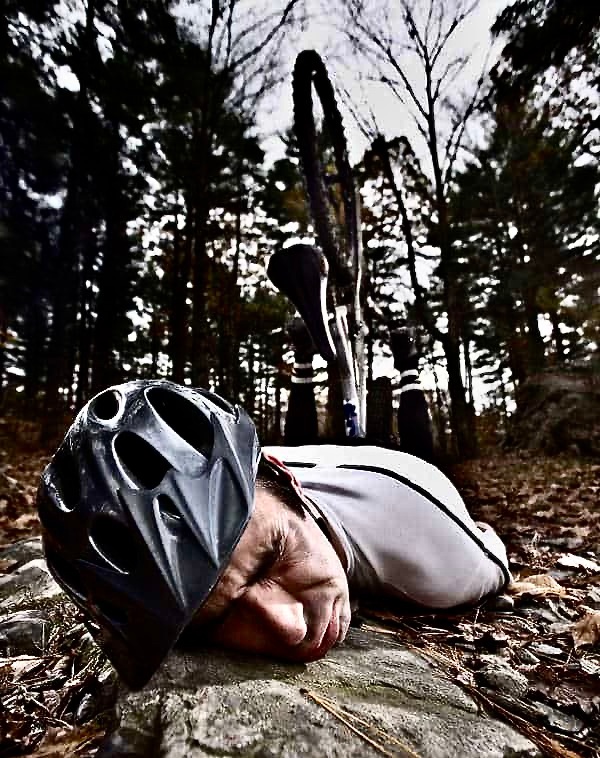
   Leaving the valley Rick suddenly slowed down ahead of me. I got tangled up in his back tire and went over the handlebars. I skinned my knee, but we were going too slow for much else to happen. “Crash test dummies!” a crow watching squawked. It took me longer to put my derailleur chain, which had fallen off, back on than it did to get over my injuries. The chain was trapped against the frame. I had to loosen the rear wheel. I cleaned my greasy hands on some of last year’s fallen leaves.

   The morning of the wedding, while my wife went shopping for a gift, I rode down into the valley. I felt good, but a strong crosswind was blowing and I got tired. The bike felt sloppy, too. Going home I pushed hard because I didn’t want to be late for the ceremony. When I finally got home, I found out I had been riding on a nearly flat back tire.

   The wedding went off without a hitch, but during the reception, when my wife was congratulating him, he made the shape of a handgun with his hand, with his index finger pressed to his temple. The next day I drove to his house with the gift we had forgotten to bring to the reception. Amy was lounging in the living room in a thick white bathrobe, poring over Cancun brochures. Skate was in her pajama’s. 

   “How’s the new life?” I asked my brother.

   “Fine,” he said. 

   By the beginning of October, the valley was starting to glow with maple red. One Sunday morning my wife and I had breakfast at the Borderline Café down the street and went for a walk on the horse trails behind South Mastick. That night, while we were watching a movie on TV, Rick called.

   “I won’t be able to ride anymore,” he said.

   “Amy?” I asked.

   “No,” he said. “It’s my shoulder.”

   I had noticed how he couldn’t lift his right arm above his head without trying hard. “After any ride,” he said, “any ride at all, potholes or no potholes, my shoulder is in a lot of pain. I’ve been taking Celebrex, but my doctor told me it’s rubbing bone on bone. There’s almost no cartilage left. He said sometime in the next couple of years, depending on how fast the rest of it goes, I’ll need a replacement shoulder.”

   “Oh, man!” I exclaimed.

   The last Saturday of the month was the last day of the year I rode in the valley. It was getting too wet and cold. I was adjusting the strap on my helmet when some neighborhood boys and girls came walking up with rakes, brooms, and a wagon. They asked if they could rake our yard for $5.00. They started pushing wet leaves into piles. The biggest of the girls walked up to me.

   “Mister, can I ask you something?” she said.

   “Sure,” I said.

   “That small boy,” she said pointing to a small boy. “He’s having a potty emergency.”

   I rang the doorbell for my wife. She came outside, saying she would take care of the boy and supervise the raking. “Go before it gets dark,” she said. It was getting dark earlier and earlier. It would soon be dark the minute I got off work.

   Where Hogsback Lane intersects with the Valley Parkway, I cut across a field and rode onto a single track. The track was littered with slapdash. A flock of Canadian geese went by overhead. They honked at me. I came around a quick bend and the branches of a fallen tree on the side of the track jabbed at my face. I swerved to the left and pulled on the brakes, jumping off the bike when the tree I was going to run into became the tree I ran into. I landed on my feet. The bike was good to go when I picked it up.

   On the way home I rode on the road, instead of the trail, hugging the shoulder’s white line. A man in a Ford F-150 pick-up leaned on his horn behind me, and when he went past, tried to shrug me off the road, giving me his middle finger for good measure. Some people are sons of bitches. There’s no getting around it. At home I hosed off the Schwinn and hung it up in the garage. I checked the tires. They looked good, although I knew hanging upside down in the garage all winter long the air would slowly seep out of them.

   When you ride with somebody else you’ve got to wait until they’re as ready as you are. When you ride by yourself you can go whenever your bike is ready. Nobody wants to be alone, but sometimes you just need to be left alone. I did yoga at home that winter to give my lower back a helping hand. I went to classes sometimes even though I couldn’t abide the pie in the sky talk. I had an indoor bike and pedaled on it. I would have to pump up my road bike tires the coming April, before going back into the valley. When I did, I would keep my eyes on the road ahead, not looking back, watching for the springtime after a long winter.

Ed Staskus posts monthly on 147 Stanley Street  http://www.147stanleystreet.com, Made in Cleveland http://www.clevelandohiodaybook.com, Down East http://www.redroadpei.com, and Lithuanian Journal http://www.lithuanianjournal.com. To get the site’s monthly feature in your in-box click on “Follow.”

“Cross Walk” by Ed Staskus

Late summer, New York City, 1956. Big city streets full of menace. A high profile contract killing in the works. A private eye working out of Hell’s Kitchen scares up the shadows.

Available on Amazon: https://www.amazon.com/dp/B0CRPSFPKP

A Crying of Lot 49 Publication