
By Ed Staskus
When push came to shove I had no idea what was going on the day I was born. I was born nine months, seven days, and some hours after the day my parents were done with the art of romance on a summer night. The day before I was born everything was so far so good. I was curled up warm and cozy in my mother’s womb. But before the day ended I was twisting and turning. I was restless all that day. The next thing I knew my parents were in a taxi in the middle of the night on their way to the hospital.
I was born in the Sudbury General Hospital of the Immaculate Heart of Mary. Everybody called it ‘The General’. The hospital had opened the year before. There were two hundred beds and it was modern as could be. The Sisters of St. Joseph used their own resources to get the region’s first English-speaking hospital built. They mortgaged all their properties to get the loan for the construction.
“They used to do this cool thing,” Ginette Tobodo, a Sudbury mother, said. “On the walls they painted certain colors, one color for the lab, another color for the cardiac department, and you just followed the color to where you needed to go. It was easy to find your way around.” My father was sure I was going to be a boy, so he followed the color blue. It took him to the cardiac department where he explained he was going to have a heart attack if he didn’t find the maternity ward.
In the end, when I was born a boy, he was on cloud nine. Courtney Lapointe’s three brothers were born at the same hospital. She was down in the dumps every time after every one of the births. “I wanted a sister so bad, I bawled my eyes out at the hospital when each one of the boys was born.”
Being born is no business for babies. It’s a man’s job. When the squeezing and pushing were all over and I looked around, I didn’t see anything recognizable. There were plenty of colors and shapes. The colors and shapes moved and made sounds. Everything more than a foot away was a mystery. I couldn’t make heads or tails of it. I was washed and swaddled and went to sleep. After I woke up I wanted to suck on something. When I smelled my mother’s milk I liked the smell and then the taste of it.
My parents had moved to a new house on a new stretch of Stanley St. It was just west of downtown and dead ended at a cliff face of nearly two billion year old rock. They had emigrated to Canada in the late 1940s, like many other Lithuanians after World War Two. Canada was happily admitting migrants who were willing to do the dirty work. My father was a blaster for INCO. He loaded bore holes with black powder charges and stood back. My mother had been a nanny for a family of thirteen but was now her own homemaker.
Sudbury is not a large city, but it is the largest city in northern Ontario. It is about seventy miles north of the Georgian Bay and about two hundred and fifty miles northwest of Toronto. There are hundreds of lakes within the city limits. It came into being after the discovery of ore in 1883. The Canadian Pacific Railway was being constructed when excavations revealed vast stores of nickel and copper on the edge of the Sudbury Basin. Something crashed there from outer space a long time ago. Few craters are as old or as large anywhere on the planet. It wasn’t long before mines were being dug and men were arriving to work in the mines. Just more than forty thousand people lived in the city the year I was born.
My first two years of life after coming home were uneventful. In the event, I couldn’t remember much of what happened from day to day, much less the week before. I was like a yoga master living in the moment. I was about two and a half years old before I came into my own. I started busting out of my toddler bed so often my father considered installing a lock on it.
As I grew up I found out there were some rules. One rule was no climbing on the radiators. Another rule was no going into the basement. The basement was where the coal-fired boiler was. It looked like some kind of monster. A third rule was absolutely no scaling the rock cliffs at the far end of our backyard.
“Behave, or Baubas will come and get you,” my mother repeatedly warned me while giving me a stern look.
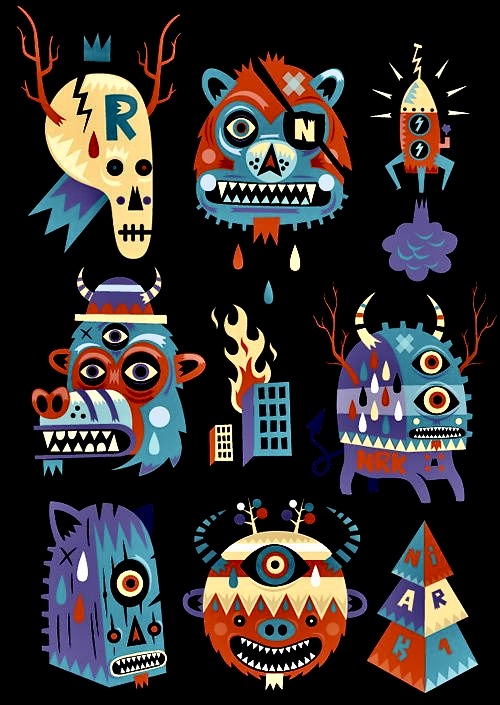
Baubas is an evil spirit from Lithuania with bloodshot eyes, long skinny arms, and wrinkly fingers. He came from the Old World to Canada with the migrants to keep their children in line. He wears a dark hat and hides his face. He supposedly slept in our basement behind the octopus-armed furnace. According to my mother he kept a close watch on my behavior. I had never seen him and never wanted to see him. Whenever I balked at eating cold beet soup my mother would knock on the underside of the kitchen table, pretending somebody was knocking on the door, and say, “Here comes Baubas. He must know there’s a child here who won’t eat his soup.”
When I told my friend Lele about Baubas, she laughed and tried to steal my security blanket. She lived one block over on Pine St. We played together every day when we weren’t fighting. Whenever we fought it was usually about my blanket. Whenever I was hard on her heels trying to get it back, she waited to the last minute before laughing maniacally, tossing it to the side, and running even faster, knowing full well I would retrieve my blanket first before trying to exact revenge on her.
Most of my friends were Lithuanians like her. The man who built our house lived across the street in a house he built for his family. He was French Canadian. Sudbury was the hub of Franco-Ontarian culture. He had two sons who were my age. Their names were Francois and Jean. They went by Frankie and Johnny. We ran up and down the street playing make believe. There weren’t many cars and even less traffic. A snub-nosed Palm Dairies milk delivery truck rolled up our street every morning. The driver drove standing up. He didn’t have a seat. The throttle and brake were on the steering column. Their bottles of chocolate milk had tabs on the top through which a straw could be stuck.
In the wintertime we skated in our yards when our fathers flooded them to make rinks. Sometimes in the morning in the sunlight the hoarfrost sizzled. We practiced falling down and trying to get back up a dozen times a day until we could stay on our blades most of the time. I only spoke Lithuanian. My two friends spoke French and English. I learned to speak English from them. We never spoke French on the street. They said it was only for girls and art critics.
They slept over one night when their parents went out to dinner and later to a wrestling match at the INCO Club. Dinty Parks and Rocco Colombo were the combatants that night. They bumped heads hard in the third round and both went down. Rocco shook it off but was drop kicked by Dinty when he tried to get up. The next second Dinty got the same treatment from Rocco. It went back and forth, each man pinning the other for a two-count until the referee finally called it a draw. When he did the two wrestlers violated one of the most holy canons of pro wrestling by shaking hands before leaving the ring. Nobody in the audience could believe it.
Sometime after dinner my two friends showed me what they had brought with them. They were magic markers. We drew a picture of Baubas pierced with arrows. We drew a picture of him running on the Canadian Pacific tracks behind our house while being chased by a locomotive. We drew a picture of him hitchhiking out of town in the direction of Gogama way up north, never to be seen again.
“Do you remember the mean green dinosaur?” Frankie asked. We had seen “The Beast from 20,000 Fathoms” earlier that summer at the Regent Theatre on Elm St. We walked there with some older boys and girls and paper bags full of popcorn my mother popped for us. We sat in the front row so we could see as much as possible. The movie was about a hibernating dinosaur woken up by an atomic bomb test. When he wakes up he becomes ferocious. He ends up in New York City where he terrorizes everything and everybody. It was the best movie ever.
When we got tired of drawing pictures they convinced me to strip down to my skivvies and drew wavy lines all over me with a green magic marker. They drew a sloppy dot on the tip of my nose. When they heard my mother outside the door the next thing I knew the marker was in my hand and my mother was demanding an explanation from me. I tried to tell her it wasn’t my fault, but she had no patience for explaining and complaining.
“Go wash that off,” she said and pointed to the bathroom.
The green marker, however, wouldn’t wash off. The ink was indelible. I called to my friends for help, and although they tried, they were more hurt than help. They scrubbed enthusiastically until those parts of me not green were red with irritation. When they were done I was red and green all over.
The tenth or twelfth time I climbed on a chair on the sly to get on top of the radiator to look out the side window was the time I lost my balance and went over the side. I stuck my arm out to break my fall and broke my collarbone. Before I knew it I was on my way back to ‘The General’. I had to wear a sling for two weeks. That wasn’t the worst of it, though.
My mother never bought anything from salesmen who went door to door selling snake oils. The next time one of them knocked on our door she did, however, buy something. It was a bottle of PolyMusion, a yellow syrup with a horrible orange rind after taste. The salesman said it was a cure-all. There was no hiding when my mother came looking for me with a tablespoon of the gooey liquid. She was nice enough to serve me blueberries afterwards.
My arm was feeling better by Victoria Day, what we called Firecracker Day. Frankie and Johnny had gotten their hands on a pack of Blockbuster firecrackers. They were five inches long and a half inch in diameter. “Do not hold in hand after lighting” was printed on top of the 4-pack. A gang of us snuck past the last house on the other side of the street and went behind some bushes at the base of the cliff. One boy had brought an old bushel basket and another boy brought an old teddy bear. The bear had a hard rubber face. We lit a Blockbuster, turned the basket upside down over it, and ran to the side. The Blockbuster blew the basket to smithereens. When it was the teddy bear’s turn we pushed a Blockbuster into a rip in his belly and ran to the side. The blast blew the stuffing out of the bear, which caught fire, some of it starting the bushes on fire. The man who lived in the last house put the fire out with his lawn hose. There was hell to pay up and down Stanley St. that night.
No matter how many times I was warned to stay away from the rock cliffs was as many times I went scuttling up them. There were Canadian Pacific tracks at the top that curled around the backside of Stanley St. One day I was exploring and lost track of time. My pockets were full of black pebbles by the time I realized what time it was. One of them was different. It was a shiny pinkish gray. Sudbury’s rock, which was everywhere, wasn’t naturally black. It was naturally pale gray. Emissions from smelting contain sulphur dioxide and metal particulates. Sulphur dioxide mixed with atmospheric moisture creates acid rain that corrodes rock. A coating of silica gel trapped particulates that coated Sudbury’s rocks black as pitch.
I ran home, jumped the railroad tracks, and scrambled down the rock face. When I burst through the back door into the kitchen I saw my mother sitting at the kitchen table. She looked distressed as could be.
“Where have you been?” she asked, angry. “I’ve been looking for you for hours. I was worried sick.” She looked like she wanted to hit me. I pulled the shiny rock from my pocket.
“I was searching for treasure,” I said. “I found this. It’s for you.” After that everything was forgiven, thank God.
The day I screwed up my courage to find out what was down in the basement was the day I turned stunt man. My father was blasting rock deep in the mines and my mother was taking a nap on the sofa. My brother, born a year-and-a-half after me, was in a Moses basket next to the sofa. He had been crying his head off lately and the only thing that stopped the flood of tears was the basket. One of my mother’s arms was over her face and her other arm was unconsciously rocking the basket. I snuck to the basement door. I quietly opened the door. I took a step down, which turned out to be a misstep, and tumbled down the rest of the stairs to the bottom. When I came to a stop after backflipping I was surprised I hadn’t cried or screamed. I was also surprised to find I was unhurt. I looked in all directions for Baubas. I thought I saw something move in the shadows. I heard hissing and whispering. It felt like something was pulling my hair. I raced back up the stairs and burst into the living room. I was in a cold sweat. My mother was still asleep. My brother opened his eyes and shot me a lopsided grin.
When I looked behind me there was no Baubas anywhere in sight. I closed and fastened the door to make sure. I needed fresh air. I went outside and sat on the front steps. Frankie and Johnny came over. The towhead had a dime in his hand.
“Look what I found,” he said. A sailboat was on one side of the coin and King George VI was on the other side.
“Let’s go to the candy store,” Frankie said, taking the dime. There was a variety store around the corner on Elm St.
“There’s a monster in our basement,” I told Frankie and Johnny while we were walking there. “We almost got into a fight.”
“I have nightmares sometimes about an unstoppable green monster wearing red pants,” Johnny said. He had been dreaming about the Mighty Draco come from outer space.
“The way to fight monsters is with your brain, not your fists,” Frankie said.
“How do you do that?” I asked.
“You think up a plan.”
“What’s thinking?” I asked.
“It’s what you do with your brain,” he said. “No problem can stand up to thinking.”
Frankie was almost a year older than me and knew everything. Johnny was half a year younger than me. He didn’t know much. He stared at his hand where the dime wasn’t anymore. I liked what Frankie had said. I could stay out of the basement but still do battle with mean old Baubas. I couldn’t wait to get home and outwit the monster. I was going to use my newfound brainpower to think him back to where he came from.
Mixing it up with Baubas was getting easier and easier.
Ed Staskus posts monthly on 147 Stanley Street http://www.147stanleystreet.com, Made in Cleveland http://www.clevelandohiodaybook.com, Down East http://www.redroadpei.com, and Lithuanian Journal http://www.lithuanianjournal.com.
“Bomb City” by Ed Staskus
“A Rust Belt police procedural when Cleveland was a mean street.” Sam Winchell, Beyond Fiction

Cleveland, Ohio 1975. The John Scalish Crime Family and Danny Greene’s Irish Mob are at war. Car bombs are the weapon of choice. Two police detectives are assigned to find the bomb makers. Nothing goes according to plan.
A Crying of Lot 49 Publication
 147 Stanley Street