Fried Eggs on Toast

By Ed Staskus

   The first language I spoke was Lithuanian and until I started meeting other kids on the street it was the only language I spoke. All my Baltic friends in Sudbury, Ontario, were other small change in the same boat. We brushed up on our language skills while their Old World parents visited my Old World parents. When spring broke early my second year of life, I started meeting other children, boys and girls living on the block of nine houses on our dead-end street. 

   They all spoke English and most of them spoke French., too. We spoke English on the street, which was how I picked up enough of it to get by. French was for talking about cooking, girls, and fashion. We didn’t know anything about those things, so we stuck to English.

   My friend and arch-enemy Regina Bagdonaite, who I called Lele, lived a block away. She and I played together, burning up the pavement, except for those times that she saw me dragging my favorite red blanket behind me. When she tried to take it away and I resisted, starting a tug of war, she resorted to biting me on the arm. It was then squabbling and pushing started in earnest, all hell breaking loose.

   Lele didn’t begin learning English until the first day she went to school. “All my friends were Lithuanian during my childhood in Sudbury,” she said. “When I started kindergarten, I didn’t speak a word of English. Many people over my lifetime had a chuckle when I told them I was born in Canada, but English is my second language.”

   Time is money is the watchword in the grown-up world, but time is candy is what works for many children. The young lady who lived next door to my parents had a daughter my age and they visited some afternoons. She always brought candy and while our mothers talked, Diana and I sat at the kitchen table with a paper bag full of candy between us. Whenever one of us was ready for another piece, we jiggled the table like crazy before making a grab for the bag.

   My parents, who were an immigrant couple, bought a house as soon as they could, the same as every other Lithuanian who ended up in Sudbury. They had three children inside of five years. They didn’t have a TV, but they had a telephone and a radio, as well as a washing machine and a fridge. They knew their neighbors, but all their close friends were other post-war DP’s, most of them working in the nickel mines. Sudbury was a municipality, but it was a company town first and foremost.

   By 1950 it had long been associated with mining, smelting, and a broken-down landscape. The environment was said to be comparable to that of the moon. Decades of mining and smokestacks had acidified more than 7,000 lakes inside a circle of 10,000 square miles. 

   “I never liked Sudbury,” my mother said. “All the trees were dried up and dead. It was god-forsaken as far as the eye could see.” More than 50,000 acres of the hinterland were barren. Nothing grew there. Another 200,000 acres were semi-barren. There was erosion everywhere. It wasn’t a wasteland, but it was a wasteland. All anyone had to do was walk up a rocky promontory and look around.

   As early as the 1920s “The Hub of the North” was open roasting more than twice as much rock ore as any other smelting location in North America. The result was poisoned crops far and wide. The aftermath made it one of the worst environments in Ontario. It blackened the native pink granite, turning the rose and white quartz black. 

   “My husband worked two weeks during the day and two weeks during the night,” my mother said. “He walked to work, except when it was too cold. Then whoever had a car would pick him and others up. In the morning he left at seven in the morning and got home at seven at night. When he worked nights, he got home at seven in the morning. The kids and I would wait by the window for him to get back.”

   Sudbury lies within a gigantic basin. It is the third-largest impact crater on Earth. It was created about 200 million years ago when an enormous asteroid rocketed through the atmosphere and hit the ground with a blast. World-class copper and nickel deposits are found there and mined extensively.

   The city’s reputation as a rocky badlands was known far and wide by the time my parents, Angele and Vytas, got married in 1949 and bought their house on Stanley Street a year later. Despite the industrial blight of the past half-century, there was a growing working-class population. They were a part of that population. The newlyweds were two of the wartime displaced willing to take whatever work was offered in return for getting out of the Old World.

   “All our friends, the Zizai, Simkai, Bagdonai, all had children,” my mother said. “Since our living room was a little bigger than most, they often came over on Saturday nights. The men played bridge while we made dinner. The kids ran around. We drank and danced. We put the kids away and talked all night.”

   Whoever had the opportunity to get married got married as fast as they could. There wasn’t an overabundance of eligible women in Sudbury. Henry and Maryte Zizys saw each other three times before they got hitched. The Simkai and Bagdonai stretched it out for a few months. The married men drank at home. The single men drank in bars, usually with other single men.

   The early Lithuanians who went to the New World weren’t Lithuanians, since the country didn’t exist at the time. It had once been its own realm but had since been taken over and was part of the Russian state. Many who fled to the United States were mistakenly documented as Polish, since the Russians had banned the Lithuanian language in the homeland and scores of them spoke Polish as a second language.

   The first Lithuanians in Canada were men who fought in the British Army against the Americans in the War of 1812. For the next 130 years most of those who left the Baltics and went to Canada did so for economic reasons. After World War Two they fled toil and trouble after the Soviet Union reincorporated Lithuania into its evil empire. 

   “All of us hated the Russians for what they did” my mother said. They deported hundreds of thousands of Lithuanians to Siberian labor camps during and after the war. Sometimes they had their conniving reasons. Other times the reason was slaphappy. The neighbors might have complained about you. The new Communist mayor might have taken a dislike to you. A cross-eyed apparatchik might have thought you were somebody else. It didn’t matter, because if you ended up in a boxcar going east, your future was over.

   The house Vytas and Angele moved into was on a new extension of Stanley Street north of Poplar Street. It wasn’t in any of the city’s touted neighborhoods, but Donovan was nearby, and so was Little Britain. Downtown was less than two miles to the east. Stanley Street started at Elm Street where there was a drug store, a tobacconist, five-and-dime, fruit market, bakery and butcher shop, restaurants, a liquor store, and the Regent movie theater. The streetcars were being replaced by busses and the tracks asphalted over. The other end of Stanley Street dead-ended at a sheer rock face on top of which were railroad tracks. The Canadian Pacific ran day and night hauling ore. When the train wailed, we wailed right back.

   My mother and her friends shopped on Elm Street. When I was still a toddler, I rode in a baby carriage. After my brother and sister were born, they rode in the carriage. I didn’t fit anymore, having become a third wheel. I was unhappy about it.

   “I told him he was a big boy now and had to walk to help his brother and sister, but he still didn’t like it,” my mother said. “He made a sour face.”

   My father spread topsoil in the front yard of our new house and threw down grass seed. The backyard was forty feet deep but sandy and grass wouldn’t grow there. He built a fence around it to discourage us from climbing the rocky hill over which the railroad tracks curved west. 

   Even though children imitate their elders, they don’t always listen to them. “We always told the kids they weren’t allowed to climb the rock hills,” my mother said. “One day I couldn’t find Edvardas. He wasn’t in the house or in the yard or anywhere on our part of the street. I called and called for him. When he didn’t answer, all I could do was wait outside. When he finally came home, he had pebbles in his pockets. Where have you been? I asked him. I was angry.”

   “I was looking for gold, mama,” I said, handing my mother pebbles that had a glint of sparkle to them. “I found some and brought them back for you.”

   Our house on Stanley Street was ten blocks from the vast open pits on the other side of Big Nickel Mine Drive. Logging and farming were what men had worked at through the middle of the 19th century, but after 1885 big copper and nickel deposits were discovered in the basin. The impact of decades of roasting ore on open wood fires killed most of the trees not being logged for the fires, except poplar and birch, which dotted the city and our street.

   “We had two bedrooms, a small kitchen, and a nice living room,” my mother said. “Upstairs was a half bath and two rooms. We rented those rooms. We usually rented to women or a couple who were new to Sudbury. Where they took a bath, I don’t know. We charged $11.00 a week for a room and saved all the money we got. Right before we left for America, my husband was able to buy a used car.”

   When Bruno and Ingrid Hauck came to Sudbury from Germany, they rented a room for several years. “She watched the kids sometimes, so Vytas and I could go to the Regency to see a movie,” my mother said. They saw “The Greatest Show on Earth” and “20,000 Leagues Under the Sea.” My friends and I saw “Lady and the Tramp” and fell in love with the movies.

   When I was four years old my parents had a New Year’s Eve party at our house, inviting all their friends. A few minutes before the magic moment my mother cut her eye adjusting the elastic strap of a party hat under her chin while sliding it up over the front of her face. “I had to lay down and didn’t see New Year’s Day,” she said, disappointed.

   When she woke up my father and Rimas Bagdonas, her dancing partner in the local Lithuanian folk dancing group, were washing the night’s dishes. Rimas worked in the mines, and wrote plays in his spare time, staging them in the hall of the nearby French Catholic church hall. “I was just in my twenties, but in one of Rimas’s plays I was the mother of a dying partisan,” my mother said. “I made myself cry by thinking about the time I cut my eye.” We all went to church  once a month when the visiting Lithuanian priest made his rounds. It cost ten cents to sit in a pew. My brother, sister, and I sat for free. Piety and silence were mandatory.

   September through November are cold, December through February are freezing cold, and March into mid-May are still cold in Sudbury. The first snow by and large falls in October, but it can show up as early as September. The season’s last snow comes and goes in April, although May sometimes experiences a late icy shower. There are never any flurries in June, July, or August. 

   My father knew how to ice skate and taught us on an improvised rink in the front yard. He hosed water out on the lawn on bitter cold days where it started freezing in minutes. When it was frozen hard as rock, we laced up our skates and went skating. Whenever all the kids on the block joined in it got pell-mell fast. My two friends from across the street and I entertained ourselves with our figure 8s.

   In the 1950s in Sudbury sulfur dioxide was an opaque, cloud-like formation across the horizon as seen from a distance. There was lead, arsenic, and God knows what else in it. The ground-level pollution wasn’t as bad, more of a gray haze, but was worse on some days than others. When it got worse, my father built an igloo for us to play in.

   It snows a hundred and more inches in Sudbury. After the streets and sidewalks are cleared there is plenty of building material. He formed blocks 4 inches high and 6 inches thick. When there were enough blocks to start, he made a circle leaving space for a door. After he stacked them, he used loose snow like cement, packing it in. He put a board across the top of the igloo door and another at the top of the dome for support. Halfway up were small windows and around the top several air holes. As long as there was daylight there were daylong Eskimos in the igloo.

   Our furnace in the basement ran on coal. It was delivered once a week by truck, the coal man filling up the bin in the basement down a chute. Every morning my father shoveled coal into it, lit the fire, and stoked the coal. At night either my mother or he banked the furnace, salvaging unburned coal and putting the ashes in bags. They saved some in a container on the front porch for the steps whenever they got iced over.

   My mother told us to never go in the basement. She didn’t invent a Babadook lurking down there, but she didn’t want us in the basement messing around. One day I started down the stairs to see what it was my dad did there every morning. I tripped over my own feet and tumbled the rest of the way down. I was back on my feet in a second, ran up the stairs and into the kitchen, and started to bawl, even though I was unhurt.

   The furnace heated a boiler that created steam delivered by pipes to radiators throughout the house. We were forbidden to stand on the pipes or scale the radiators. It was the basement all over again. “I didn’t have to worry about Richardas and Rita, they were too small, but Edvardas was always trying to climb up on the radiator in the living room,” my mother said. “I told him he was going to fall off and one Sunday night, while I was cooking, he fell off and broke his collarbone, although he didn’t cry when it happened. He seemed more surprised than anything else.”

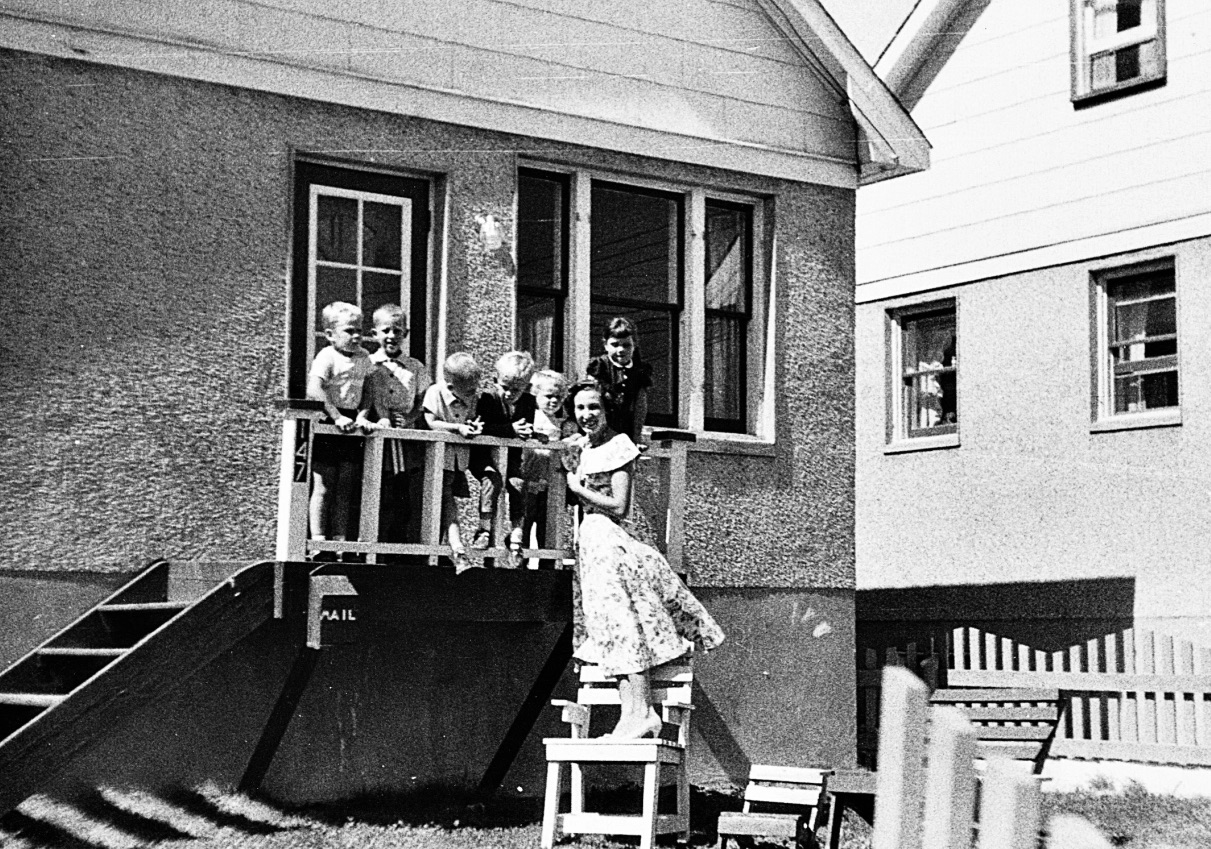
   For the rest of the next week, my arm in a sling, my mother fed me my favorite food every morning, fried eggs on toast. I was the envy of my sidekicks, the two Canadian boys across the street from whom I had learned most of my English. After finishing their porridge, they ran over to our back porch and watched me through our kitchen window go one-handed at my sunny side up breakfast.

   I saluted my pals with my fork before getting back to business.

Photograph by Rimas Bagdonas.

Ed Staskus posts monthly on 147 Stanley Street http://www.147stanleystreet.com, Made in Cleveland http://www.clevelandohiodaybook.com, Down East http://www.redroadpei.com, and Lithuanian Journal http://www.lithuanianjournal.com

“Cross Walk” by Ed Staskus

“Captures the vibe of mid-century NYC, from stickball in the streets to the Mob on the make.” Sam Winchell, Beyond Fiction

Available on Amazon: https://www.amazon.com/dp/B0CRPSFPKP

Late summer and early autumn. New York City, 1956. President Eisenhower on his way to the opening game of the World Series. A hit man waits in the wings. A Hell’s Kitchen private eye scares up the shadows.

A Crying of Lot 49 Publication

High and Low

By Ed Staskus

   When your back is to the wall, you’ve only got one place to fall, which is face down. I didn’t want to do that. I had gotten married the year before and it was time to buckle up. I needed a steady job. I called Doug Clarke and asked if I could see him. I was looking for a piece of the pie.

   “Absolutely,” he said.

   “What’s a good time?”

   “Any time after lunch.”

   We made a time for the following Monday. I made sure to be on time. Doug was behind his desk at the back of the office, which was a bullpen style office. A half-eaten sandwich lay at his elbow. He was a few years younger than me and at least a hundred times the capitalist I was. He had his own Gilded Age going. Phones were ringing off the hook. Merchandise were being talked up. Money was being made, by hook or by crook.

   I first met Doug when he was in a small building on Linda St. in Rocky River, Ohio. It was going on the late 1980s. He had been set up in business by his father, who was an account manager for Philips Lighting. Doug was selling commercial lighting and had lately started selling tanning bulbs. Philips had developed fluorescent tanning tubes for the European market. They were new on the American market. They were going like hot cakes.

   Light Bulb Supply was three of them in the beginning, Doug, the owner operator, his salesman Marty Gallagher, and Chuck Pampush, who ran the warehouse and did the driving. The company truck was a red F150 Econoline and was called the Lightmobile. Doug had an office, but Marty’s desk was in a hallway leading to the warehouse. They had been friends growing up, but weren’t going to stay friends for long. As tanning bulb sales grew by leaps and bounds Marty jumped ship and set up his own distributorship. The split went to court, there were claims and counterclaims of theft of trade secrets, but in the end, they both stayed in operation, personal enemies and business rivals.

   Randy Bacon, Chuck’s brother-in-law, helped in the warehouse now and then unloading deliveries and stocking shelves. He had a tattoo inside his mouth under his front lip. It said, “Fuck You.” I gave him a wide berth whenever I saw him. I gave his junkyard dog a wider berth. The pooch was unusually tense and snarled all the time.

   By the time I sat down with Doug he wasn’t in Rocky River anymore. He had outgrown his start-up warehouse. He had moved five miles east to Lakewood on the third floor of a hybrid industrial and commercial building, renting space and then more space.

   “What can you offer us?” he asked me.

   “I can offer you 20-some years. After that it’s up for grabs.”

   “Steady Eddie, is that right?”

   “Whatever you say,” I said unwittingly, saying something I ended up saying over and over for a long time.

   “All right, you’re hired.”

   We shook hands. Doug clapped me on the back. It ended up being twenty-two years of the daily grind. In the end I didn’t get a handshake on my way out, although I had not expected one, given the family business I had signed up with. I wasn’t part of the family.

   When Doug was still in Rocky River I had teamed up with a friend of mine and set up a small tanning salon across the street from the Cleveland State University campus. We were in a five-story brick building at East 21st St. and Euclid Ave. The Rascal House Saloon was across the street. It was where concert goers at Peabody’s Down Under went for a middle of the night  fest after shows. The Plain Dealer called it “Cleveland’s Best Pizza.” I went there whenever I was famished and down to a couple of bucks. 

   We were on the lower level. Bill Stech, an architect, and the landlord, was on the top floor. He always wore the same black suit, white shirt, and black tie. He had black hair that looked phony. He always made promises and usually broke his promises. After a while I stopped taking it personally. Whenever he didn’t want to see me, his receptionist said he wasn’t in, even though his car was parked in the back lot in its customary space. Sometimes I could even see him in his office, at his desk, his back turned to me.

   My business partner was a full-time fireman in Bay Village, so I did most of the full-time work at the tanning salon. I also drummed up side jobs at other salons, trying to make myself useful, doing repairs, selling, delivering, and installing bulbs. I kept my head above water, but I was treading water. When Doug hired me for part-time sales, I opened a savings account.

   Doug had moved to the Lake Erie Screw building in Lakewood. Madison Park was in front of the building and Birdtown was all around us. The neighborhood was not the greatest. Everybody made sure their cars were locked up tight in the parking lot. One day after work, as I walked to my car, I saw a dead bird stuck headfirst in my front grill. I hadn’t heard or felt him hit the car that morning. He was stiff and there were flies buzzing around him. I pulled him out, rolled him up in a newspaper, and took him to the park, where I laid him down in a pile of rotting leaves.

   The brick pile we were in was going on a hundred years. It was on 18 acres with plenty of parking. From 1917 to 1924 it had been the Templar Automotive Plant. They built cars, trying to compete with Detroit. Dave Buehler, a Lakewood native, collected cars and had more than a dozen of the Templars. He restored them and kept them stashed in our building on the same floor where they had first been assembled. I sat in one of them one day. It was sizable enough but uncomfortable. The steering wheel was king-size and the mirrors were tiny. It looked like it would transition into a coffin at the first whiff of an accident.

   The building became Lake Erie Screw in 1946 when John Wasmer took it over and started manufacturing fasteners. In the 1970s he added large bolts to their line-up and growth accelerated. When most fastener manufacturers moved to China, the Wasmer family kept up the beat of the hometown and their growth continued apace. By the mid-90s the company was doing about a hundred million dollars in annual sales, all of it in cap screws and structural bolts.

   In the beginning my job was as thankless as it gets in the world of commerce. I had a cubicle the width of a toilet stall and was expected to make cold calls until the end of time. I got sick of it every day at the beginning of the day. There were few overworked business owners who wanted to talk to an eager beaver trying to sell them something. The other salesmen sat back and waited for calls to come to them. They racked up commissions while I racked up zeros.

   It took longer than I wanted, but I finally went full-time, got a real desk, and got to answer in-coming calls. I sat between Betty the typist and Jim Bishop. Betty was a looker who never looked at me, except when she had something obnoxious to say. She was doe-eyed about Doug. Even though Doug had a girlfriend who was going to be his wife soon enough, the gossip was that he and Betty were close.

   He had a bedroom through a locked door behind his desk.. There was an immense waterbed and a mini fridge. There were posters of muscle cars and hot girls on the walls. There were piles of dirty clothes and old mail everywhere. He wasn’t especially tidy. Being the boss, he didn’t need to be.

   One day when I was on the phone with a customer, Betty broke into her song and dance about what I was doing wrong and what I should be doing right to win more friends and influence people enough to make them buy our goods. She didn’t stop even when I finished the call and was writing up the sale. I finally got fed up and said so.

   “Look, shit for brains,” I said loud enough for anybody listening to hear. “You take care of your business at that typewriter over there and I’ll take care of mine over here.” Nobody dropped a pin in case I had more to say. Betty sniffed and went to the bathroom. I went to Doug’s desk and apologized for the outburst. He laughed it off. I never apologized to Betty. She was never going to be Mrs. Doug Clarke, anyway.

   We were riding the wave of the tanning boom. We had more sales than we knew what to do with. Doug rented additional space to stock our bulbs and hired more packers. They worked overtime day after day. Trailer loads of bulbs from Cosmedico, Wolff Systems, and Light Sources rolled in every Friday. We sent small orders out by UPS and FedEx, and pallet orders out by LTL. We were busy as bees.

   Doug started out as Light Bulb Supply selling run-of-the mill commercial lighting. The tanning bulbs we sold under the name of Ultraviolet Resources were making him rich, but we still sold all kinds of incandescent, fluorescent, and high-pressure bulbs. I got into the swing of it and lent a hand, even though the commissions were less. Jim Bishop was the lead man. He sat on the other side of me. Betty hated him more than she hated me. He never stopped baiting her, no matter what, staring intently at her while twisting a strand of hair.

   I couldn’t make him out. He looked like hell, even though John Elias, another salesman one desk down, told me he was trying to “hold on to his youth.” That horse was out of the barn. He lived in the Warehouse District, in the Bradley Building, which was an early pioneer of downtown Cleveland’s revitalized housing. He wore his hair long, down to his shoulders, dressed better than anybody else in the office, and only took calls when he wanted to. He snorted coke on his lunch hour and was always more personable when he got back to the office.

   He was never personable to Betty. Coming back from lunch he liked to stop at her desk and hover over her without saying a word and breathing heavily.

   “What do you want now?” she asked.

   “What if I told you I was gay?” he asked.

   “Just go away, please,” she hissed.

   Kathy Hayes was Mrs. Doug Clarke in the making. There was no mistake about that. She was Doug’s pit bull sales manager. She brought her sister Maggie into the business, then her brothers Kevin and John. Kathy came from a family of thirteen. More brothers and sisters came and went as the need arose. Kevin, John, and Maggie stayed. Kevin and John became Archie and Jughead in my mind. Maggie became the Wicked Witch of the West. I put her out of my mind.

   Kathy was the Queen of Mean. She was a mix of go-getter, unapologetic yuppie greed, and a hair trigger temper. She calmed down after her kids were born, but never lost the mean streak. She was my immediate boss, so I watched my step. She was a sharp gal. I was fake polite to Archie, Jughead, and the Wicked Witch. They were easy enough to do that to, like pretending to water fake plants.

   After I cold called myself into Kathy’s good graces, I settled into a routine of Monday through Friday. It wasn’t what I wanted to do but it was what I had to do. The only concession I was able to wrangle was a starting time of 11 AM to be able to work at my part-time job, which was more remunerative but not as steady. My steady job meant I would be getting a predictable paycheck every two weeks, making good on my bills, and paying into a 401k, which were good things. I never worked overtime and never volunteered for anything. They didn’t pay me enough to go an extra inch, much less a mile. The American Dream is only real for those who say so.

   Towards the end of the millennium Doug broke ground on a new state-of-the-art warehouse and offices in Brook Park. He spared no expense. It was 45,000 square feet next door to the 230-acre Holy Cross Cemetery. There were dedicated 18-wheeler loading docks and a separate dock for the delivery services. The head honchos had sizable offices with windows. There was a gym and a party center on the second floor. The lunchroom was all stainless steel and a huge flat screen. Christ on a cross was fixed to the wall above the front entrance doors. The cross looked like a cactus. Jesus looked like he needed to scratch an itch.

   It rained money like nobody’s business. One day a Middle Eastern man walked in with a paper bag stuffed with more than $50,000 in cash. He was setting up a tanning salon. We were outfitting it with the equipment. I wrote up the sale but didn’t bother counting the loot. I left that to the Wicked Witch, who scowled testily when I poured the legal tender out on her desk.

   We moved into our new building, shiny and up to date, at the beginning of the new century. It was the beginning of the end. It took five or six years but Light Sources, whose tanning bulbs were Doug’s meal ticket, decided they wanted a bigger slice of the pie. They offered Doug a choice. He could sell the tanning division to them, they would send somebody from headquarters to run things, or he could decline their offer, in which case they would open their own operation somewhere else, bypassing him entirely . Doug went with the flow. Everything and everybody stayed put.

   It didn’t do any good. Inside a few years Light Sources moved themselves to Westlake. Archie, Jughead, and the Wicked Witch jumped ship and went with them and Doug was left holding the bag. He lost a boatload of money in the stock market downturn of 2007. As the second decade of the century unfolded, he had to shed most of his remaining staff, including me, sell his deluxe building, find an older, smaller building, then find something even smaller, until he finally ended up in a strip of mom-and-pop shops in Avon selling odds and ends. His kids didn’t re-enroll at their private schools. He lost his McMansion in North Ridgeville. His rich friends became his former friends.

   In life Doug bore a resemblance to the late-night TV talk-show host Johnny Carson. He had a warm smile and went out of his way to make most people feel good, even though he was as oriented to the bottom line as any manhunter. He was elected president of the Brook Park Chamber of Commerce, where everybody was a manhunter. He spent money on himself and his family like he had money to burn. The money ran out slowly but surely. By the time he died there wasn’t much left to burn.

   Doug died when he was struck by a semi-truck trailer on Interstate 90 near his mom-and-pop. It was 2018 in the middle of a sunny day at the beginning of summer. He was taken to University Hospital in Avon where he was pronounced dead. He had been standing outside of his car on the shoulder for a few minutes before he walked onto the marked lanes of I-90, according to the Ohio State Highway Patrol. They couldn’t explain why he had stepped into oncoming traffic.

   It happened so fast the truck driver didn’t have a chance to touch his brakes. “I feel bad for the victim,” Dan Darko of nearby Elyria said. “It sucks to feel pushed to that point. But I feel worse for the driver. One person’s choice will affect him for the rest of his life to the point where he may never be able to do his chosen profession again.”

   It was hard to believe it was an accident, but it was harder to believe Doug had deliberately stepped onto the highway. He was a Roman Catholic, taught Sunday School at his church, and was a member of Religious Readiness. According to Rome, death by suicide is a grave matter. The church holds that one’s life is the property of God and to destroy that life is to wrongly assert dominion over God’s creation. I never knew how sincere Doug was about his faith. I knew he sincerely valued prosperity. I don’t know if he had lost his faith. I knew he had lost his prosperity.

   The funeral was at St Clarence in North Olmsted. He left a wife and four kids behind him. All his in-laws who had bailed on him when Light Sources swallowed the golden goose were there. I didn’t go to the service. I had never been close to Doug or Kathy, anyway, keeping my distance. His in-laws liked to talk loud about what they were contemptuous of. The less I saw of them the better. 

   If Doug stepped in front of the semi-truck trailer on I-90 on purpose, I wondered if he did it for his kids. He probably had a locked and loaded life insurance policy. There might have been a suicide clause limiting the payment of benefits. Maybe he thought he could kill two birds with one stone if it looked like an accident. He could stay in the good graces of the church and still provide for the future of his family.

   Nobody never does not have a good reason for ending it all, especially if they believe hope is gone and not coming back. My memory of Doug is dulled by how he died. The chief thing I now remember about him is how his determined drive for riches and status in this life came to an end on a stretch of godforsaken concrete.

Ed Staskus posts monthly on 147 Stanley Street http://www.147stanleystreet.com, Made in Cleveland http://www.clevelandohiodaybook.com, Down East http://www.redroadpei.com, and Lithuanian Journal http://www.lithuanianjournal.com

“Cross Walk” by Ed Staskus

“Captures the vibe of mid-century NYC, from stickball in the streets to the Mob on the make.” Sam Winchell, Beyond Fiction

Available on Amazon: https://www.amazon.com/dp/B0CRPSFPKP

Late summer and early autumn. New York City, 1956. President Eisenhower on his way to the opening game of the World Series. A hit man waits in the wings. A Hell’s Kitchen private eye scares up the shadows.

A Crying of Lot 49 Publication