
By Ed Staskus
One of the concerns of Cleveland’s early settlers was that Canada might invade at any time. They were just on the other side of Lake Erie and they had plenty of boats. They might land their Canuck army somewhere in the middle of the night and lay siege to the city. Nobody knew what they would do if they captured Cleveland, they being foreigners who lived on bacon and poutine and littered their mother tongue with ”eh?” Everybody was convinced it was going to happen soon. What could they do?
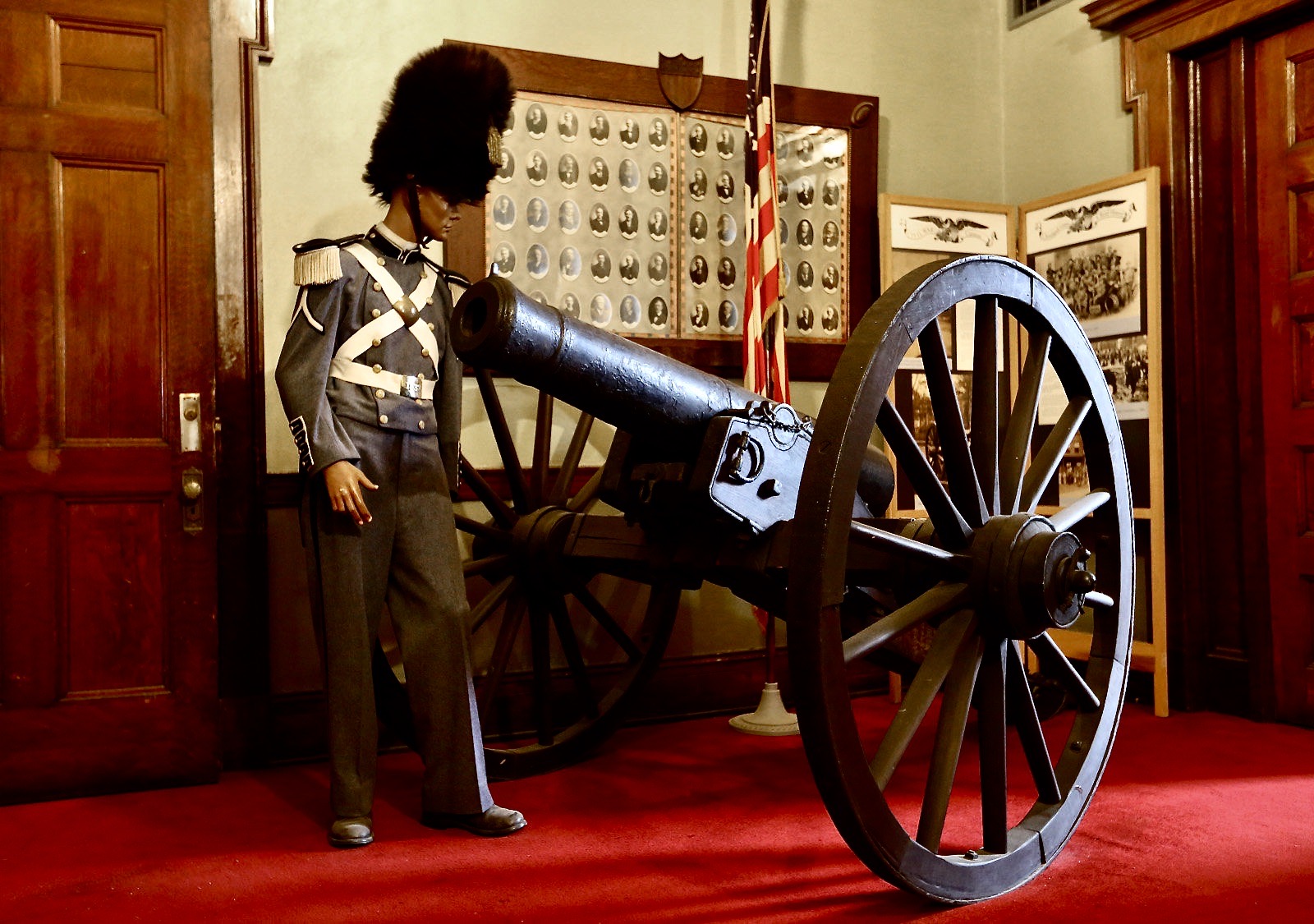
When the city fathers finally acted they formed the Cleveland Grays, a volunteer military company, to protect themselves from Canucks on the loose. They weren’t called the Grays at first. At first they were called the Cleveland City Guards but since their uniforms were gray from tip to toe they changed the name the next year. They wore Queen’s Guard bearskin hats that made them look a foot taller than they really were. They adopted “Semper Paratus” as their motto. Nobody knew what it meant because it was in Latin until the man upstairs finally explained it meant “Always Prepared.” Everybody liked that. There were 65 of them. They stayed prepared after that.
The Cleveland Grays stayed busy even though the Canadians eventually decided to stay on their side of the border. In 1852 they put down a two-day riot at Cleveland’s Medical College. A mob bearing clubs and cleavers attacked the school, protesting the work of Resurrection Men. They were men who robbed graves of the recently deceased for dissection lectures. The rioters broke into the college. The doctors, teachers, and students fled while the bully boys destroyed all the furnishings and equipment. They ransacked the lower level looking for the body of a local woman who they believed had been body snatched. The Grays restored order, but the next day the roughnecks were on their way to burn down the house of one of the anatomy teachers when the Grays had to save the day again. The rioters saw their bearskin hats a mile away and snuck away.
In 1861 they were the first militia in the country to form a company and respond to the call for Union soldiers. They fought at the First Battle of Manassas. They hauled the first ever captured Johnny Reb cannon of the war from the Cheat River battlefield back to Camp Cleveland in Tremont. The troops called it ‘Cannon Sesech’ after the secessionists. They fired it after every Union victory. They whooped it up loud and clear every hour for 24 hours on the day the war ended. Nobody complained about the noise. Over the years, after a Gray had been a member for twenty-five or more years, he was entitled to be called a “Pioneer” and to wear a leather apron with his uniform. He was also entitled to carry an axe when on parade. Nobody messed with them when they were on parade. They fought in the Spanish-American War and World War One.
After that the Militia Act proscribed them and their like from fighting in wars anymore on their own initiative. Uncle Sam still wanted them but only if they wore his regulation uniform. The Cleveland Grays lasted as a “Businessmen’s Camp” into the 1990s.
They first set up shop on the fourth floor of a building called the Mechanics Block. Thirty years later they needed more space. They moved into a former fire station. Ten years later they moved into the newly built City Armory, sharing it with the Ohio National Guard. Soon after that a fire destroyed the building. They decided to build their own place that would stand the test of time.
A three-ton block of sandstone was set in place in 1893 where Bolivar Rd. meets Prospect Ave. for the foundation of the Grays Armory. It grew to be three stories high with a five-story tower on the northeast corner. It was built as an urban fortress. There is a black iron drop-gate and iron barriers in front of the solid oak front doors. Iron rods were bolted to the brick walls as window protectors.
The armory was built to store weapons and ammo. The drill room, which doubled as a ballroom, was where the Grays marched up and down in tight formations. But it wasn’t long before it became a kind of Blossom Music Center. The Cleveland Orchestra’s first concert in 1918 was staged there. The first time the Metropolitan Opera came to town they sang songs of doomed love and hellfire there. When John Philip Souza first marched into town his band played there.
Even though in the early 1970s I was living on Prospect Ave. near Cleveland State University, and later in nearby Asia Town, I didn’t know the first thing about Grays Armory. The few times I saw it I dismissed it as an old ramshackle castle with a cool-looking tower. I did, at least, until Joe Dwyer invited me to his new digs there.
Joe and I went to St. Joseph’s High School the same four years in the 1960s and for a few years in the 1970s lived a street apart in Asia Town. Many of the suburban kids who went beatnik and hippie in those days moved downtown like us. Many of us lived in reduced circumstances, trying to keep our heads above water, living catch as catch can in our counterculture world. Joe was living rent-free in the caretaker’s quarters on the top floor of the tower. He was keeping a part-time caretaking eye on the armory.
He showed me around the building. He told me it had just been added to the National Register of Historic Places. It looked like a forest had been chopped down for the floors, doors, stairs, and wainscoting. It was a sunny day and sunlight poured in through the windows. Everything was old but gleaming like new. We played a game of pool in the Billiard Room. We peeked into the basement where there was a 140-foot-long shooting range. We played some haphazard notes on the Wurlitzer pipe organ that had been installed a couple of years earlier. It came from a silent movie theater in Erie, Pennsylvania. It sounded creepy in the empty ballroom. Three or four concerts a year were being sponsored by the Western Reserve Theater Organ Society.
Twenty years later my wife and I were living in Lakewood when we received a friend’s wedding invitation in the mail. The reception was being held in the main ballroom of Grays Armory. We checked the box saying we would be attending the festivities. My wife bought a new dress and I polished my dress shoes,
We parked on Erie Ct. alongside the Erie Street Cemetery on the day of the big day. It was where Lorenzo Carter, the first permanent settler of Cleveland, was buried. It was where Chief Joc-O-Sot, who fought the first settlers, was buried. It was where almost a hundred Civil War veterans were buried, including General James Barnett, who was a commander of the Cleveland Grays. After the war he served on the commission that got the Soldiers’ and Sailors’ Monument built on Public Square. We walked to the end of the block to the armory. The lobby was carpeted in red. There was some kind of ancient ticket booth off to the side. There was a grand staircase. The posts and railings were carved from a single slab of wood. The posts were engraved with ‘CG’ for Cleveland Grays.
After toasts, dinner, a slice of wedding cake, and some dancing, we were standing around when somebody in our group said the armory was haunted. “Lots of people have seen ghosts here,” the man in the know said.
“Like who?” I asked.
“Plenty of people,” he replied.
“I saw a handsome young man with light brown hair, parted on one side, with a crown imperial goatee,” said Chris Woodyard, who has written a series of books about haunted places. “The spirit was wearing a Cleveland Grays woolen jacket, decorated with a glockenspiel pattern down the front, formed by braids and buttons.” Staff members said a woman wearing white often appeared at the armory’s piano. She didn’t play it but no matter where it was moved to, she was always there. She wanted to dance but didn’t have a partner. Day and night doors locked and unlocked themselves and disembodied sinister voices whispered in the shadows. Ghostly footsteps were forever setting off security alarms.
One day the spirit of a soldier walked through a wall to get into the ballroom. A cleaning man was mopping up after a party. He watched the spirit watching him. A woman spirit wearing a party dress appeared and walked up to the man spirit. When the cleaning man coughed the spirits melted away. Another day a maintenance man was working at the back of the ballroom when a glowing green hand closed the door. He ran to the door, and opened it, but there was nobody there. The door knob oozed wormwood.
After another drink my wife and I went looking for spooks. “Don’t bother looking for Lou,” we heard a voice behind us say. “He’ll find you.” My wife didn’t like the sound of that, but she was game and went with me. “Who is Lou?” she asked.
Lou was a caretaker who once lived at the top of the tower in the same quarters Joe had lived in. He died of a heart attack making his rounds. He still made his rounds. Most ghosts are about unfinished business. He often walked behind people in the ballroom. When they heard his footsteps they turned to see who it was, but there was never anybody there, although they could smell the aroma from his cherry-vanilla pipe. Whenever there was a meeting in the first-floor tower room, where there was an oversized potted plant, he liked to shake it violently until it fell over.
“Do you believe in ghosts?” I asked my wife.
“Not during the day,” she said.
“How about at night?”
“I’m a little more open-minded at night.”
It had gotten to be night when we went on our self-guided tour of Grays Armory. We went upstairs. We stepped into the Club Room where the Grays used to sit around and puff on stogies. There were comfy leather sofas. The mahogany was dark and the atmosphere cozy. We stepped into the Billiard Room where Joe and I had shot pool years earlier. There were antlers of long dead deer on the walls. We peeked into the rooms on the upper floors. One of them was a smaller ballroom for meetings. Back in the day folks wanted to be high up so they wouldn’t have to smell the horse shit in the street. There were unlit fireplaces everywhere. We found cupboards in the Mess Room where members used to hide their booze during Prohibition. There wasn’t a drop of spirits left.
With every step we took we had the feeling somebody or something was behind us, but every time we looked around we were alone. After a while being alone got scary. It’s better to be alone than to be in bad company, I reassured myself.
“Maybe we should go back,” my wife suggested.
“We’re not after fish but let’s do a little more fishing,” I said.
We went up and down the tower. We stepped into the ground floor room. The lights went on by themselves. We heard footsteps and bumps in the night. A big dusty potted plant that looked like it was a hundred years old started to shake. It fell over.
“That’s enough fishing for the day,” my wife said, backing up.
In the end we didn’t see any ghosts, except for maybe Lou, which wasn’t to say we were ready to say there weren’t any. The Ghost Hunters, a paranormal team on the TV show SyFy, rooted around Grays Armory one day and found evidence of hauntings. Every time they left a room something closed the door behind them. When they investigated the basement they heard an unseen somebody say “Hello.” When they left the voice said “Goodbye.” They concluded there were spirits, but they seemed to want to have a good time more than cause a ruckus. Ghosts just want to have fun sometimes.
“Have you ever noticed that ghosts are always wearing clothes?” my wife asked.
“I’ve noticed without really noticing it,” I said.
“How do their clothes get into the other dimension with them?” she asked.
“That’s a good question,” I said. “If you ever get the chance, ask one of them.”
“There’s a fat chance of that ever happening,” she said.
We hadn’t seen anything substantial but we had seen enough. We had felt the presence of spirits in the shadows. We went back to the wedding reception in the ballroom. The bride and groom were the life of the party on the dance floor. True love can be like a ghost. Everybody talks about it but not many have ever seen it. They were doing the hustle to a Bee Gee’s tune being spun by the DJ. Disco is a surefire remedy for ghost sightings. The Lady in White, the lonely dancing spirit who had long haunted the armory, was nowhere in sight. She was dancing to her own tune.
“Feel the city breakin’ and everybody shakin’, and we’re stayin’ alive, stayin’ alive,” the Bee Gees sang in their eerie falsetto voices.
Ed Staskus posts monthly on 147 Stanley Street http://www.147stanleystreet.com, Made in Cleveland http://www.clevelandohiodaybook.com, Atlantic Canada http://www.redroadpei.com, and Lithuanian Journal http://www.lithuanianjournal.com.
“Cross Walk” by Ed Staskus
“Captures the vibe of mid-century NYC, from stickball in the streets to the Mob on the make.” Sam Winchell, Beyond Fiction
Available on Amazon: https://www.amazon.com/dp/B0CRPSFPKP
Late summer and early autumn. New York City, 1956. Jackson Pollack opens a can of worms. President Eisenhower on his way to the opening game of the World Series where a hit man waits in the wings. A Hell’s Kitchen private eye scares up the shadows.
A Crying of Lot 49 Publication

 147 Stanley Street