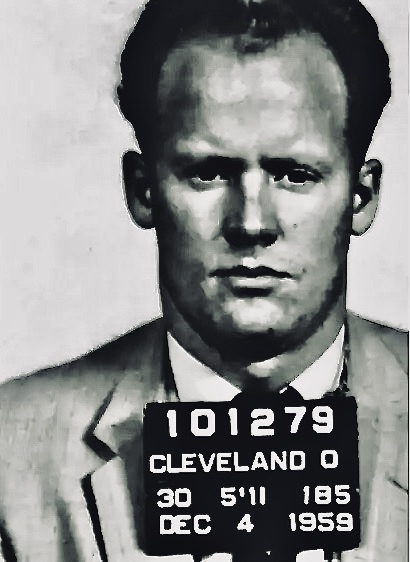
Outside the Law

By Ed Staskus

   Everybody called Danny Greene the Irishman. He was almost forty two years old the summer of 1975 and somehow still alive. He had never looked his age, but that had changed, although he still didn’t look his age. He looked older. Water under the bridge hadn’t done him any favors. He grew a mustache to take attention away from his thinning hair. On top of that, at the moment, he felt bad. He didn’t feel bad about Lorcan Sullivan being blown up in Lakewood two days earlier. He was in a rage about that. That was different. His mouth hurt bad. A bum tooth was a different kind of misery. He called his dentist, who knew well enough to get him in no later than right away.

   He lay down with his face on a pillow on the floor of the trailer home in Collinwood that had become the Celtic Club. His live-in girlfriend Denise Schmidt knelt over him and massaged his back. It had been tightening up every night the past two months. He was stiff as a board most mornings. He felt like an old man sometimes. Denise was a senior at Collinwood High School. She was on the young side of more than half his age. She made him feel younger. The bomb blast hadn’t slowed her down. 

   Two months earlier at four in the morning while they were sleeping on the second floor of their two-story storefront home on Waterloo Rd. somebody had thrown two bombs through the ground floor windows. The storefront was where Danny Greene had a phony consulting firm on the ground floor that went by the name of ‘Emerald Enterprises.’ The enterprise was mainly in the business of extortion. The Irishman’s other enterprises were gambling, embezzlement, loansharking, and leg breaking. Murder was taken for granted in his line of work.

   When the sound of glass breaking woke him up, he slipped out of bed and into the kitchen. He had a gun in his hand. When the first bomb that came through the window exploded, he was crouching between the sink and the refrigerator. A cabinet was above him. He was safe in his improvised nook when timbers and bricks started to fall, but when the floor caved in he went down with it. Denise was still in bed. She and the bed went down, too. The bed ended up halfway down from the second floor, tilted and dangling from a beam. She hung on until she couldn’t hang on anymore.

   “I felt the floor give out,” the Irishman said. “The next thing I knew I was in a heap of rubble. A busted icebox was beside me. Denise fell on top of me. I dug the two of us out. I heard dogs barking. I couldn’t hear my cats.”

   “Danny Greene made out like Houdini,” Ed Kovacic, the Central Station police lieutenant investigating organized crime, told Frank Gwozdz and Tyrone Walker. “He was luckier than his cats.” Danny Greene had two street cats who nightly slept inside the building on the first floor. They were both killed. His new 1975 Lincoln Continental was destroyed. A second bomb was connected to a two-gallon can of gasoline. That bomb didn’t go off and the gasoline didn’t ignite. The Irishman had more lives than a clowder of cats.

   The Bomb Unit got to work before dawn after the blast. Across the street a disheveled hippie sat on the curb waving a bottle of Boone’s Farm at anybody who gave him a glance. “You should a heard just what I seen,” he said to anybody who came within earshot. Nobody paid any attention to him. Even he had a hard time paying attention to himself.

   When the rubble was cleared away Danny Greene set up shop in the same place, parking a trailer home there. A TV news crew interviewed him outside his new headquarters. He announced his new address and invited any other would-be bombers to try again. “I’m in between both worlds, the square world and the street world,” he said. “I think I have trust on both sides, but I have no ax to grind. If somebody wants to come after me, we’re over here at the Celtic Club. I’m not hard to find.” He was shirtless, bare-chested, and spilling over with contempt. He pointed to the medal of St. Jude he was wearing around his neck. “This is why nobody is going to get me.” 

   Parents in the neighborhood warned their children not to go near the trailer with the Irish flag flying in front of it. They told them it was best to stay away from that whole block, St. Jude medal or no St. Jude medal.

   Danny Greene’s mother died when he was three days old. His father got drunk and stayed drunk after she was buried. He lost his job with Fuller Brush. When he did he dropped the baby boy off at the Parmadale Orphanage. Six years later, back on his feet, newly married, he took the boy back, but the first grader argued long and loud with his stepmother and ran away again and again. One night he ran away to his grandfather’s house in neighboring Collinwood and never went back.

   His grandfather put him into St. Jerome’s Catholic School where he became an altar boy and all-star basketball player. He joined the Boy Scouts. After graduating from grade school he went to St. Ignatius High School. After that things started to go south. He was thrown out of the Boy Scouts for fighting with other scouts. He was expelled from St. Ignatius for fighting with the Italian pupils and everybody else. He transferred to Collinwood High School but was expelled for “excessive tardiness.” He explained he had to fight his way into the school, fighting the bullies blocking his way, but the principal didn’t believe a word of it and told him, “Leave and don’t ever come back.”

   “He grew up hustling,” said his one-time friend Aggie who ran with Danny Greene when they were kids. “It’s hard to take the hustle and larceny out of somebody who grew up with nothing. Being an orphan and growing up with the nuns, you tend to grow up edgy, tough, and slightly mean.” Hardly anybody stayed friends with the Irishman for too long. The nuns put him in their prayers, to no great effect.

   He enlisted in the Marine Corps. They liked his fighting spirit. He became an expert marksman. Before long he was training other marksmen on Sniper Garand rifles. When he was discharged he was honorably discharged. He went home to Cleveland to be his own man. He was done with running away. He had a brand-new plan. He started working on the waterfront. He was elected president of Cleveland’s Local 1317 International Longshoreman’s Association, the dock workers union, in 1962. The trouble started right away when he began embezzling union funds. He was living large and needed the money. Trouble picked up the pace when he started leaning on his longshoremen for more money.

   “Danny was spending money hand over fist,” said Skip Ponikvar, vice president of the union. “His trips to the Theatrical Grill downtown, trips to Chicago, trips to New York. And he was picking the tabs up. There was only so much a few hundred men could support with dues. He got the idea to have some guys work the grain boats on the side and sign the checks over to the union. The guys started bitching and moaning about it. Well, if you worked on the grain boats, when it came to the hiring hall later on, those guys were given the better job, which is illegal.”

   Longshoremen started shaking down employers for payoffs. One of them threatened to kill the children of a businessman who wouldn’t cooperate. His house had to be put under police protection and his children escorted to school by an armed guard. After one too many complaints, the Cleveland Police Department sent Ed Kovacic and his partner to set Danny Greene straight. It wasn’t a far drive to the union hall. They stopped for coffee and a smoke. Refreshed, they walked into the union hall quietly, looking for the back office. They didn’t mean it to be a pow wow. They hadn’t brought a peace pipe.

   “When we walked in, I felt like I’d fallen in the Atlantic Ocean, because it was all green,” Ed Kovacic said. “Even the walls were green.” The only thing not green was the Irishman, at least from the neck up. “Everything was green except his hair and face. He handed us a pen, which had green ink in it. Everything was pleasant until he asked why we were there.” They told him why they were there. “He got up and started walking around the room. As he did, he got louder and louder. He started talking about how the Italians thought they ran Collinwood, and this was just a bunch of tough Irish and Slovenian kids who were going out there and telling them they didn’t run Collinwood anymore. I handed him our crime report and said, ‘How about this man? Your goons blinded a Chinese American man.’ Boy, that really set him off like a rocket! Finally, he said, ‘Get out. That’s enough. We’re done.’” 

   The policemen were done, too. “When we got in the car, I said, ‘That was like a scene from that waterfront movie. He was acting like Marlon Brando.’ My partner said, ‘Yeah, I was waiting for him to start hollering, ‘Stella! Stella!’” Ed Kovacic didn’t bother telling his partner he was getting his movies mixed up.

   Danny Greene didn’t want or need anybody like Stella. Blanche was more his speed, at least if she had been half her age. He knew how to get what he wanted. He liked blondes who were blonde as sunlight. The nuns at St. Jerome’s had tried to teach him the difference between angels and demons, but he never learned his lesson.

   “He was dynamic,” Skip said. “Dressed to the nines. You never saw him in jeans or street clothes. Suit and tie all the time. He negotiated a hiring hall for the union. It allowed us control. Total control. If you were my friend, I’d send you on a boat that’s going to work ten hours. And if you weren’t my friend, or just an average guy, I’d send you on a boat that’s going to work four hours. He had ‘Don’t fuck with me’ written all over him. You didn’t want to even challenge him. He was always in shape. He didn’t smoke. But when he drank, that was his weakness. He drank to excess, and when he drank to excess, bad things would happen, arguments, fights, all kinds of bad things.”

   Danny Greene was in shape but couldn’t fight everybody in the union. He was outnumbered. Everybody finally wanted him gone. “The men wanted him out,” said John Baker, one of the dock workers. “They didn’t want to work the boats for nothing. When he got into his jam, he asked me for a vote of confidence, and I said, ‘Danny, I can’t do it.’ That was it. We never talked after that.”

   The national union suspended him. He was done running Cleveland’s docks. Somebody drove past his house and pumped five bullets into the clapboard, just to make sure he got the message. When a TV reporter showed up the next morning the Irishman read from a scrap of paper, “Effective immediately, I have resigned as a member and officer of Local 1317. After nearly four years of devoting all my energies to get the dock workers in Cleveland a fair shake, I found that my only compensation is headlines in the newspaper and bullets through my window.” When push came to shove he pled guilty to falsifying union records and was fined $10,000. He never spent a day in jail and never paid a penny of the fine. By that time, he was a part-time FBI informant and the FBI didn’t care whether he paid his fine, or not. They had bigger fish to fry.

   Danny Greene stayed on the floor for ten minutes after Denise was done with his rubdown, rolling over on his back, grasping his knees, and pulling them into his chest. He rocked forward and back. When he stood up he felt like his old self. He went outside and sat down a lawn chair in the dirt front yard in front of his trailer home. Two empty cans of Stroh’s lay at the feet of a plaster leprechaun beside the chair. He used to do next week’s drinking every day of the week but had put a stop to most of it. He had started jogging, gulping vitamins, and steaming vegetables for dinner.

   His dentist’s appointment wasn’t for two more hours. The tooth yanker was in Lyndhurst, twenty some minutes away, so there was plenty of time to think things over between now and then. He had gotten a new Lincoln Continental and enjoyed driving it. What he didn’t enjoy was checking it from front to back and underneath it for anything that might blow its top. Denise wouldn’t go near the car until he was done.

   He was going to make somebody pay for blowing up his building and killing his cats, never mind the car. He was going to make somebody pay for Lorca Sullivan’s death, too. He knew more about revenge than any man alive. He was going to make somebody pay for something, if it was the last thing he did. He was nothing if not a man of his word, no matter how many twists and turns his words might take.

Excerpted from there crime novel “Bomb City.”

Ed Staskus posts monthly on 147 Stanley Street http://www.147stanleystreet.com, Made in Cleveland http://www.clevelandohiodaybook.com, Atlantic Canada http://www.redroadpei.com, and Lithuanian Journal http://www.lithuanianjournal.com

“Bomb City” by Ed Staskus

“A police procedural when the Rust Belt was a mean street.” Sam Winchell, Beyond Books

Available on Amazon: https://www.amazon.com/dp/B0F1LM1WF9/ref=sr_1_1?crid=2MYAQAOZIC2U9&dib=eyJ2IjoiMSJ9.hTm7BGbiQbSe5ZapFwYPPfcwOpTe-Vdg6VLE4aGyTyk.Z0R-VNBWWEcvKcNaO9LdCOUnNIOOXgvYkRS_FXiXuHk&dib_tag=se&keywords=bomb+city+ed+status&qid=1742136726&sprefix=bomb+city+ed+staskus%2Caps%2C84&sr=8-1

Cleveland, Ohio 1975. The John Scalish Crime Family and Danny Greene’s Irish Mob are at war. Car bombs are the weapon of choice. Two police detectives are assigned to find the bomb makers. It gets personal.

A Crying of Lot 49 Publication

Day of the Snapper

By Ed Staskus

   After we got married my wife and I bought a home in Lakewood a few houses east of the Rocky River valley and set up housekeeping. It was the early 1990s. We tore all the lime green shag carpeting out, tore all the false ceilings out, and tore all the wallpaper off the walls, painting them white. We purged the original bathroom. The house was built in 1922 and the bathroom had to go. It was only the beginning, but at least it was a start.

   After a few years we thought we would get a cat. My wife wanted a darkish long haired. I wanted an orange short haired. We got a fluffy orange Maine Coon. He was a half-breed, but well bred. The few times he misbehaved it was mostly because we hadn’t made it clear to him that some behavior, like scratching the furniture, was out of bounds. After we let him become an inside outside cat, all the scratching he did after that was outside. We never asked the local trees shrubs or fences whether they minded, or not.

   He stayed indoors during wintertime, except when it was above freezing, as well as those times he was simply close to the side door and I tossed him outside, which I did whenever there was a snow mound beside the door. If the snow was fluffy enough, he sank into it up to his eyeballs, looked helpless for a second, scrambling to get out of the snow, and giving me a dirty look rushing back inside. Maine Coons have a reputation for enjoying snow. Our cat didn’t live up to the reputation. He was good with rain, tolerated snow showers, but not blizzards or northern Ohio winter wind storms.

   We named him Snapper after a movie we had recently seen, “The Snapper,” which is about a big family in a small house in Dublin whose oldest daughter has gotten pregnant, but won’t tell anybody who the father is, because it happened after a wild night at a pub with a man who is her father’s friend and is her father’s age. She tells everybody it was a friendly Spanish sailor passing through town. The family calls the baby in the belly the Snapper.

   I called our cat Bud. My wife called him Snaps, Snapper Doodle, Kinney, Lambkins, and Goose. He didn’t answer to much unless he was hungry, wanted to go outside, or wanted to come back inside. He didn’t like to be bothered when he was catnapping, which was more often than not. He never answered to Bud, or anything else, when he was wholeheartedly asleep.

   Snapper didn’t tell us who his parents were. He didn’t say a word about his brothers and sisters, or uncles and aunts. He didn’t tell us where he was from or how he had gotten to where I found him, which was the Cleveland Arcade. He was vocal enough when it came to food and creature comforts but didn’t like talking about himself.

   It was Thanksgiving and Christmas time. I was downtown to pick something up from a store in the Cleveland Arcade. The whole placed was dolled up for the holiday. It used to be called the Crystal Palace. I parked near the Main Library and went in through the Superior Ave. doors. When I did, I noticed the Animal Protective League had taken a vacant storefront for the time being and was peddling dogs and cats. When I looked around, I spied our new kitten in a cage at eye level in the middle of the store. I extended my index finger into his jail cell, he took it into his mouth, and bit me. He was a youngster somewhere between 10 and 12 weeks old. He might have been able to puncture paper, but not me.

   “You’re for me, bud,” I told him.

   I told the man behind the sales counter I was going to my car to get money to pay for him. When I got back a young lady had him in her hands and was walking to the counter. I stepped up to her, tapped her on the shoulder, took our cat away from her, and said, “He’s spoken for.” She gave me a sour look and went looking for another one before another one of me came along.

   The Maine Coon is one of the oldest breeds in the United States. Nobody knows exactly where they came from, but many believe they are related to both Siberian and Norwegian Forest cats. They are the official state cat of Maine. Down Easters say the breed originated in their state. Others say they are the only original American cat.

   The legend I like best is that when Marie Antoinette, the ill-fated Queen of France, was trying to beat feet out of the country, she enlisted the help of Captain Samuel Clough. She loaded his ship with all her favorite stuff, including six of her favorite cats, Siberians and Turkish Angoras. Her luck was bad, though. The Gendarmerie dragged her back to Paris before the ship could sail. When the ship sailed the six cats sailed with it. After they reached the town of Wiscasset, Maine they went into town on shore leave, living it up with the local breeds. They didn’t make it back in time when the ship shoved off, developing into the modern kind of Maine Coon. 

   My mother-in-law was owning and operating a deli takeout on the ground floor of the National City Bank building on East 9th St. My trip downtown had also meant picking up dinner for myself and my wife. I needed to get food for the new guy, too. I parked on Short Vincent. I didn’t want to leave the cat in the car, so I smooshed him into the pocket of my winter coat.

   “What’s that wiggling in your coat?” my mother-in-law asked handing me a bag full of good food. The cat stuck his head out of the top of my pocket sniffing at the bag.

   After oohing and awing at the furball she gave me a wicker basket for him to sleep in. He slept in the basket that night and for years afterwards. He never suffered from insomnia. Even when we bought a bigger and better basket for him, he continued sleeping in the original until he couldn’t fit into it anymore. When he grew up, he had a white ruff on his chest and a two-layered coat, a silky undercoat under longer guard hairs. He wasn’t as big as a purebred Maine Coon, but more than hunter savvy enough. He was more than sociable with us since we were his feedbag.

   At first, we thought we would keep him indoors, but he was as much dog as cat and had to go outside, no matter what. When spring arrived, we started letting him out and teaching him to stay away from the street. I let him wander around, following with a squirt gun, and whenever he drifted down the driveway to the apron squirted him in the face. He didn’t like it and learned his lesson, at least until he got older, when all bets were off. Our backyard was fenced on three sides and raised above the alley behind our house. Three or four houses both sides of us was as far as he ranged sideways. 

   I was watching him walk up the sidewalk one day when a full-grown cat came sauntering his way. Snapper was still a tyke. They sniffed at each other. Our guy made a sudden movement and the other guy swatted him. When he went running the other cat followed him. He jumped and I gathered him up in my arms. The neighborhood bully sat at my feet watching while Snapper made faces at him, throwing caution to the wind, snarling, and showing his claws. He could be sassy. Cats fight all the time. Even when they are playing, they get scratched. That doesn’t keep kittens from happening. They are both wild and domestic at the same time.

   Over time he learned and remembered what our cars sounded like and hearing my wife or me pulling into the driveway ran out of the backyard to see us. I didn’t like him doing it and blared my horn to make him stop doing it, but he never did. He went his own way.

   We lost him one day in the night when he got trapped inside a neighbor’s garage after the man unwittingly closed the door on him, but he was such a loudmouth that his cries alerted everybody to where he was. He could have been a civil defense siren. He knew to come inside at sunset, but sometimes forgot, sitting under our bedroom window in the middle of night meowing until we let him in the house. He slept with us on our bed, taking up a third of it. He liked his space.

   Snapper was a mouser, bringing half dead mice to the door for our approval. He messed with anything that moved. Since we lived on the edge of the valley park, there were plenty of squirrels, rabbits, possums, and racoons. He never caught a rabbit, but one day a racoon caught him. We were searching for him the next day when I found him curled up in the back of a closet. There were gobs of dried blood on his face and puncture wounds on one side of his mouth.

   “It looks like a coon hooked him,” the vet said, sewing him up and shoving an antibiotic down his throat. “Give him one of these every day for a week.” Giving him the pills was easier said than done.

   He was a birder, too, although birds were usually too fast for him. One day a pair of blue jays were in our backyard bird feeder when he went after them. That was a mistake. One of the birds flew away but the other one circled back and started dive bombing him. Snapper had no answer for the loud jeers and attacks of the big bird and ducked under a hedge sulking. The rest of the summer he scanned the sky and made sure there were no blue jays in his neck of the woods before he went exploring.

   By the time his second summer rolled around he could jump to the top of any fence, climb any tree, and even make his way to the top of flat-roofed garages. He came down from trees backwards, but I usually had to get a step ladder to get him down from roofs. He often bit off more than he could chew. I kept him in shape by holding him upside down and tossing him up in the air. He twisted at the top of the arc, aligning himself head up feet down, landing on my open hands. He rarely misjudged it, nailing the landing. It stood him in good stead his long lifetime.

   Indoor cats live about 12 to 17 years. One way or another outdoor cats live about 2 to 5 years. Maine Coons live about 10 to 13 years. Snapper was half Maine Coon and half who knows what. He spent half his life indoors and half his life outdoors. The more time he spent in the great outdoors the more wary he became of the animal kingdom, especially people and their ways. He always had the same expression on his face, whether it was a June bug or an ax-murderer coming his way. He was able to snap to attention out of a deep sleep in a split second. Snapper never let anybody get near him unless we were nearby. He was smarter than he knew. He lived to be nearly 18 years old. 

   We fed him wet food in the morning and kibble the rest of the time. We started him off with top shelf wet food until he made it known that anything with gravy was his favorite. After that Iams and Science Diet were out. Cheap-ass Friskies were in. He might have lived on gravy alone if we let him. We didn’t let him, but we tried to keep him happy. “When my cats aren’t happy, I’m not happy. Not because I care about their mood but because I know they’re just sitting there thinking up ways to get even,” the writer Percy Shelly once said.

   As much time as he spent outside, he was a homeboy at heart. When we went on vacation, whether it was for a week or a month, the minute we got back he started complaining about our absence and stayed close to us for days afterwards. After that it was back to his gravy and his basket.

   He got slower towards the end of his life. When winter came, he slept near the furnace registers. His kidneys started going bad. We added a second litter box so he could pee the second he had to. 

   One summer day coming home from work I turned into our street behind another car. Snapper was across the street from our house, on our neighbor’s front porch. Hearing my car, he jumped up and started running across the street. He was still fast enough for his age, but not fast enough that day. The front tires of the car in front of me missed him but when one of the back tires struck him, he went up into the air, landed with a thud, and rolled over. I watched the car not stop. I stopped in the middle of the street. He was still alive when I ran to him, but just barely.

   He was spasming and crying. He was broken. He was choking on blood. I forced his mouth open so he could breathe. He sucked on my finger and died. He wasn’t the kind of cat who had nine lives. Snapper had one life and his life was over in the blink of an eye. I wrapped him up in that week’s issue of the Lakewood Observer and took him down Hog’s Back Lane to the park, burying him on the banks of the Rocky River. He had never been to the park but lived on the edge of it. He saw it every day of his life from our second-floor porch.

   Two years later we got another mixed Maine Coon. He was a black classic style tabby. My wife named him Gladwyn but called him Baby Wodin, after the pagan god of the Anglo-Saxons. She called him Gladdy often enough so that I started calling him Gaylord, after the crafty old Cleveland Indians pitcher Gaylord Perry. When winter came and went, he liked sitting on Snapper’s cat perch on the porch and looking out at the valley going buds and blossoms.

   Every spring I go to where I buried our cat and sit by the river in the sun watching ducks take their young out for a swim on the greenish-brown water. Snapper was like me in some ways. Whenever I chased him he went running. Whenever I ignored him he came purring.

Ed Staskus posts monthly on 147 Stanley Street http://www.147stanleystreet.com, Made in Cleveland http://www.clevelandohiodaybook.com, Atlantic Canada http://www.redroadpei.com, and Lithuanian Journal http://www.lithuanianjournal.com

A New Thriller by Ed Staskus

Cross Walk

“A once upon a crime whodunit.” Barron Cannon, Adventure Books

“Captures the vibe of mid-century NYC.” Sam Winchell, Beyond Fiction

Available on Amazon: https://www.amazon.com/dp/B0CRPSFPKP

Late summer and early autumn. New York City. A Hell’s Kitchen private eye. The 1956 World Series. President Eisenhower at the opening game. A killer in the dugout.