
By Ed Staskus
“Oy, where is that you are coming from?” Kieran Foyle asked the kitten going on tomcat at his feet. The half-pint was looking up at him. He had been on board the ferry when Prince Albert’s gunman shot Tom Spate dead. As the ferryman was spitting out his last breath, the kitten jumped off his perch and scurried to the side. He watched Kieran roll, push, and kick the dead Englishman into the Stanley River. He floated face down into the New London Bay. The Kulloo flying overhead didn’t bother glancing down at the end of Tom Spate.
That was the end of Queen Victoria’s would-be killer, at least until he sank. When he did bottom feeders like eels would eat whatever was left of his decomposing body. The kitten had seen plenty of eels in his short time on Prince Edward Island. He knew what they were up to. It was why he never snacked on them.
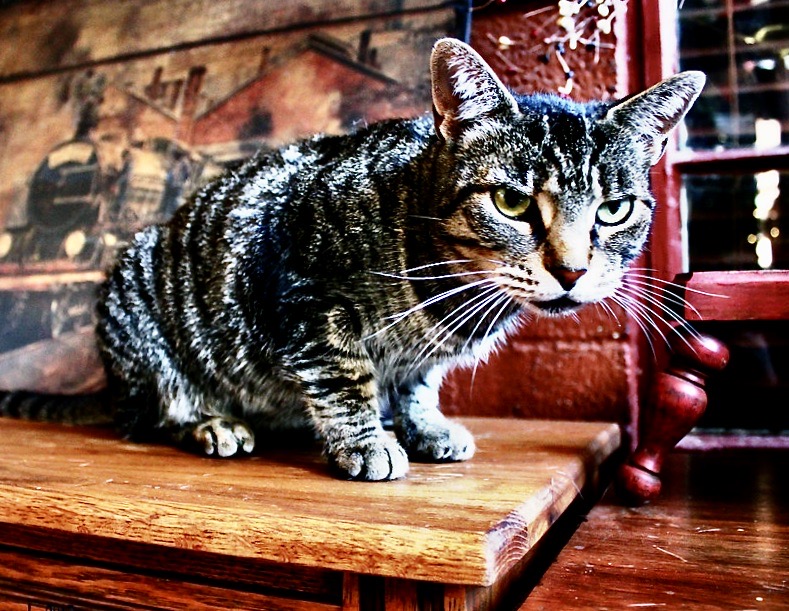
The kitten was striped and gray, still small but on the stocky side. “The only true animal is a cat, and the only true cat is a gray cat,” Lucy Maud Montgomery said. The Green Gables author had two of them. “When people ask me why I want to keep two cats I tell them I keep them to do my resting for me.”
Snapper was a Scottish half-breed from Rear Settlement, on the west side of Settlement Rd. beside a tributary of the Montague River. Everything had gone wrong a month before when Ann Beaton, the woman who had given him his name and kept him fed, dry, and warm, was murdered when somebody smashed the back of her head with a grubbing hoe.
Ann was 41 years old and a spinster. She was lonely but had a one-year-old daughter to keep her company. Nobody knew who had gotten Ann pregnant. She had a lot of explaining to do but kept it a secret. She had called the bun in the oven her snapper. When she found the kitten, who had wandered away from his litter, she called him Snapper. She lived with her brother Murdoch and his family. The night she was killed was the day she went visiting her neighbor who was weaving some cloth for her. They had tea and raisin pie after dinner and Ann started for home when it was near to sunset.
“What do you say, it’s getting awful dark, maybe you should stay overnight,” her neighbor suggested.
Ann said she knew the way back like the back of her hand and besides, she enjoyed walking in the dark. Her brother was away and one of his children was watching her girl. She wanted to get back to her young one. Ann was found dead the next day in a ditch at the back of her brother’s farm. She was lying in blood day-old dry and caked.
She was laid out in the barn. She had been stamped on and violated. Her body and dress were marked with the prints of a shod foot. Everybody from the community filing past the viewing laid a hand on her. There was a Scottish belief that if a murderer touched the body of his victim, blood would gush forth. At the end of the viewing everybody was in the clear. There had not been any gushers. The killer was never found.
Snapper stayed alert as Kieran walked back to North Rustico. He bounced up and down in the man’s coat pocket. The island’s pioneer days weren’t over, except where they were. Most still farmed and fished, but not all of them. Some made and sold farming implements while some worked in shipyards. Everybody needed lumber and many men worked at lumbering. There were sawmills and shingle mills. There were schools, churches, and post offices. There were some inns and hotels. There were plenty of distilleries.
Ann Beaton’s funeral was presided over by the Reverend Donald McDonald, a minister of the Church of Scotland. He had a large following of “kickers” and “jumpers.” They were known that way for the religious frenzy they fell into while being “under the works.” The clergyman had emigrated from Scotland to Cape Breton and finally to Prince Edward Island. Everybody knew he drank too much when he was still a Scotsman. When he became a Canadian, he tried to stay on the wagon. “Prince Edward Island is a dubious haven for a man fleeing demon rum,” one of his kinsmen said. There was plenty of strong drink on the island.
A year before her death Ann attended several prayer meetings and while under the works had knocked a Bible and a candle from Reverend McDonald’s hands. She invertedly kicked the Bible, too. She purposely blew out the candle. “They are both under her feet now and mark the end of that girl,” the clergyman said by way of a sour eulogy.
Snapper watched country folk going to Cavendish by horse and buggy to buy tea, salt, and sugar. If they had something extra in their pockets, they bought molasses and tobacco. They only bought clothes they couldn’t make themselves. They didn’t buy food as a rule. They grew and processed it themselves, picking and preserving berries, milking cows and churning cream for butter, and curing beef and pork after slaughtering the animals.
The grubbing hoe that killed Ann Beaton belonged to Archibald Matheson. He lived nearby on the Settlement Rd. with his wife and son. The three of them were arrested on suspicion of the crime. Some local women reported being molested by the farmer. But bad feelings among neighbors weren’t facts. He and his family were soon released. He may have had a bad reputation, but so did Ann. There were rumors she had been killed by a jealous wife. A smutty ballad was composed describing her as “light in her way.”
After the funeral she was buried in the Pioneer Graveyard. Her brother moved away nobody knew where. Nobody knew what happened to her baby, either. Nobody wanted to know. By the time Snapper was on his way to North Rustico everybody had done their best to forget all about it.
The kitten had been sleeping in the back of a wagon one day almost a month after Ann’s death. He was sick and tired of nobody feeding him. Before he knew it the wagon was on its way. When he looked back, he didn’t see anything worth going back to. He made himself comfortable and went with the flow. The flow went towards the northwest. The wagon stopped overnight at Saint Andrews and the next night at Covehead before getting to the Stanley River, where it rang for the ferry. Once they were across, and the wagoner was stretching his legs, Snapper stretched his legs, too. When he was done the wagon was long gone. Unlike wagoner’s hauling freight, the kitten wasn’t on a schedule. He was go-as-you-please footloose.
Tom Spate’s young wife took him in, poured him a bowl of milk, and fed him scraps of white fish. He bulked up and stayed agile by staying out of Tom Spate’s way. The ferryman had a bad temper and wasn’t above hitting his wife or trying to kick the kitten. Snapper was fast and none of the ferryman’s kicks ever landed. Tom Spate’s wife wasn’t fast enough and had the bruises to prove it.
Snapper wasn’t overly distressed to see the dead as a doornail Tom Spate floating away. Kieran was his kind of man, irascible but not mean-hearted. I have never known anyone worth a damn who wasn’t irascible, the kitten thought. Snapper stayed where he was, not jumping ship. Besides, he had already spotted foxes along the coastline. He would deal with them once he was grown up and ready for bear, but for the moment he kept his eyes open and his nose on high alert.
He saw a lighthouse in the distance. It was weather-beaten. He was farsighted but saw well enough so long as it was a few feet past his nose. He made good use of his nose and ears for everything closer. They walked past a house where it was wash day. Behind the house was a field of sunlit rapeseed. A woman was raising water from a well with a bucket and washing clothes on a washboard with home-made laundry soap. She pressed what clothes needed to be pressed using an iron she heated on her kitchen stove. Snapper didn’t own or wear clothes and thought it was a lot of bother.
A traveling tailor was walking up the path to a nearby house. He was going to stay for several days, maybe even a week, making wool coats for everybody. The lady of the house had already spun, dyed, and woven the cloth. What Snapper didn’t know was winters on the island were long and cold. He was going to find out soon enough. When he did, he was every day going to sniff out wool so he could curl up into it.
When they got to North Rustico there was still plenty of daylight left in the day. Snapper ran behind the boarding house where Kieran was staying and started pawing at a beetle. He batted it one way and another way. The beetle looked for a tree to scurry up. The only beetles Snapper never messed with were lady bugs. He liked the way they went about their business as they hunted for aphids. They were deadly killers of the pests. Snapper never killed lady bugs. It would have brought bad luck. Everybody knew that.
Snapper slept on Kieran’s bed that night. He made himself small and pressed himself into the man’s ribs. The Irishman didn’t toss and turn, which suited the kitten. He didn’t have to catnap with one eye open, ready to jump at any minute. He slept better that night than he had in many nights. By the morning he had forgotten all about Tom Spate.
Excerpted from the book “Ebb Tide.”
Ed Staskus posts monthly on 147 Stanley Street http://www.147stanleystreet.com, Made in Cleveland http://www.clevelandohiodaybook.com, Atlantic Canada http://www.redroadpei.com, and Lithuanian Journal http://www.lithuanianjournal.com.
“Ebb Tide” by Ed Staskus
“A thriller in the Maritimes, out of the past, a double cross, and a fight to the finish.” Sam Winchell, Beyond Books
Available at Amazon: https://www.amazon.com/dp/B0CV9MRG55
Summer, 1989. A small town on Prince Edward Island. Mob money on the move gone missing. Two hired guns from Montreal. A constable working the back roads stands in the way.
A Crying of Lot 49 Publication
 147 Stanley Street