Back in Action

By Ed Staskus

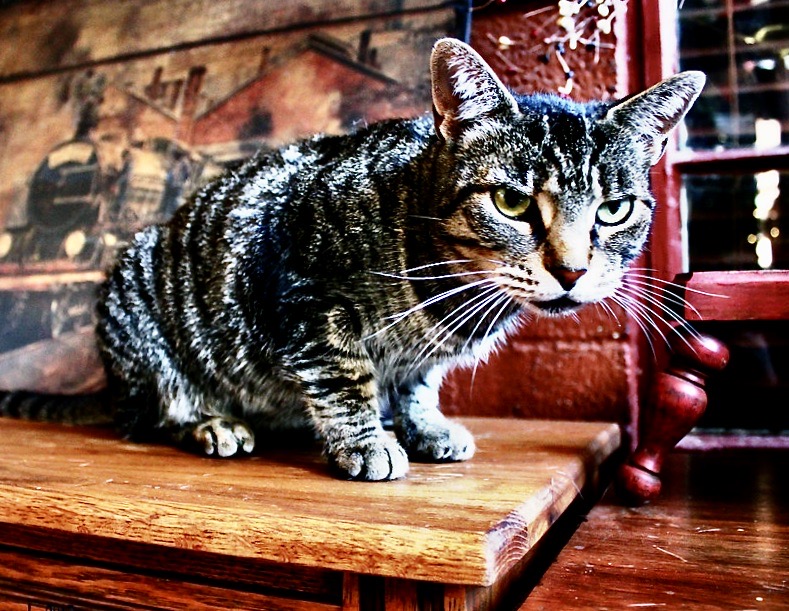
  “Oy, where is it you are coming from?” William Murphy asked the pussycat going on tomcat at his feet. The half-pint was looking up at him. He had been in Thomas Spate’s coat pocket when Prince Albert’s hired gunman shot him dead. As the ferryman was spitting out his last breath, the cat jumped out of his pocket and scurried to the side. He watched Bill Murphy roll push kick Tom Spate into the Stanley River. He floated face down into the New London Bay.

   That was the end of Queen Victoria’s would-be killer, at least until he sank. When he did bottom feeders like eels would chew on whatever was left of his decaying decomposing body. The cat had seen plenty of eels in his short time on Prince Edward Island. He knew what they were up to. It was why he never snacked on them.

   The kitten was striped and gray, still small but on the stocky side. “The only true animal is a cat, and the only true cat is a gray cat,” Lucy Maud Montgomery said years later while writing about the Green Gables girl. She had two of them. “When people ask me why I want to keep two cats I tell them I keep them to do my resting for me.”

   Snapper was a Scottish half-breed from Rear Settlement, on the west side of Settlement Rd. beside a tributary of the Montague River. Everything had gone wrong a month before when Ann Beaton, the woman who had given him his name and kept him fed dry and warm in bad weather, was murdered when somebody smashed in the back of her head with a grubbing hoe.

   Ann was 41 years old and a spinster. She was lonely but had a one-year-old daughter. Nobody knew who had gotten Ann pregnant. She had a lot of explaining to do but kept it a secret. She called the bun in the oven her snapper. When she found the kitten, having wandered away from his litter, she called him Snapper. She lived with her brother Murdoch and his family. The night she was killed was the day she went visiting her neighbor who was weaving some cloth for her. They had tea and raisin pie after dinner and Ann started for home when it was near to sunset.

   “What do you say, it’s getting awful dark, maybe you should stay overnight,” her neighbor asked.

   Ann said she knew the way back like the back of her hand and besides, she enjoyed walking in the dark. Her brother was away and one of his children was watching her girl. She wanted to get back so she could watch the young one herself. Ann was found dead the next day laying in a ditch at the back of her brother’s farm, day-old blood dry and caked.

   She was laid out in the barn. She was a mess. She had been stamped on and violated. Her body and dress were marked with the prints of a shod foot. Everybody from the community filing past the viewing laid a hand on her. There was a Scottish belief that if a murderer touched the body of his victim, blood would gush forth. At the end of the viewing everybody was in the clear. The killer was still on the loose.

   Snapper stayed alert as Bill Murphy walked back to North Rustico. He bounced up and down in the man’s coat pocket. The island’s pioneer days weren’t over, except where they were. Most folks still farmed and fished, but not all of them. Some made and sold farming implements while some worked in shipyards. Everybody needed lumber and many men worked at lumbering. There were sawmills and shingle mills. There were schools, churches, and post offices. There were some inns and hotels. There were plenty of distilleries.

   Ann Beaton’s funeral was presided over by the Reverend Donald McDonald, a minister of the Church of Scotland. He had a large following of “kickers” and “jumpers.” They were known that way for the religious frenzy they fell into while being “under the works.”

   The clergyman had emigrated from Scotland to Cape Breton and finally to Prince Edward Island. Everybody knew he drank too much when he was a Scotsman. When he became a Canadian, he tried to stay on the wagon. “Prince Edward Island is a dubious haven for a man fleeing demon rum,” one of his kinsmen said. There was plenty of strong drink on the island. A year before her death Ann attended several prayer meetings and while under the works knocked a Bible and a candle from Donald McDonald’s hands. She invertedly kicked the Bible. She purposely blew out the candle.

   “They are both under her feet now and mark the end of that girl,” the clergyman said by way of a sour eulogy.

   Snapper watched country folk going to Cavendish by horse and buggy to buy tea, salt, and sugar. If they had something extra in their pockets, they bought molasses and tobacco. They only bought clothes they couldn’t make themselves. They didn’t buy food as a rule. They grew and processed it themselves, picking and preserving berries, milking cows and churning cream for butter, and curing beef and pork after slaughtering the animals.

​   The grubbing hoe that killed Ann Beaton belonged to Archibald Matheson. He lived nearby on the Settlement Rd. with his wife and son. The three of them were arrested on suspicion of the crime. Some local women reported being molested by the farmer, but he and his family were soon released. Bad feelings among neighbors weren’t facts. He may have had a bad reputation, but so did Ann. There were rumors she had been killed by a jealous wife. A smutty ballad was written describing her as “light in her way.” 

   After the funeral she was buried in the Pioneer Graveyard. Her brother moved away nobody knew where. Nobody knew what happened to her baby, either. Nobody wanted to know. By the time Snapper was on his way to North Rustico everybody had done their best to forget all about it.

   The kitten was sleeping in the back of a wagon one day almost a month after Ann’s death. He was sick and tired of nobody feeding him. Before he knew it the wagon was on its way. When he looked back, he didn’t see much worth going back to. He made himself comfortable and went with the flow. The flow was towards the northwest. The wagon stopped overnight at Saint Andrews and the next night at Covehead before getting to the Stanley River, where it rang for the ferry. Once they were across, and the wagoner was stretching his legs, Snapper stretched his legs, too. When he was done the wagon was long gone. Unlike wagoner’s hauling freight, the kitten wasn’t on a schedule. He was go-as-you-please footloose.

   Tom Spate’s young wife took him in, poured him milk, and fed him scraps of white fish. He bulked up and stayed agile staying out of Tom Spate’s way. The ferryman had a bad temper and wasn’t above hitting his wife or trying to kick the cat. Snapper was fast and none of the ferryman’s kicks ever landed. Tom Spate’s wife wasn’t fast and had the bruises to prove it.

   He wasn’t overly distressed to see the dead as a doornail Tom Spate floating away. Bill Murphy was his kind of man, gruff but not mean-hearted. “I have never known anyone worth a damn who wasn’t irascible,” he thought. Snapper stayed where he was, not jumping ship. Besides, he had already spotted foxes along the coastline. He would deal with them once he was grown up and ready for bear, but for the moment he kept his eyes open and his nose on high alert.

   Snapper saw a lighthouse in the distance. It was weather-beaten. He was nearsighted and needed spectacles but saw well enough a few feet past his nose. He made good use of his nose and ears for everything closer. They walked past a house where it was wash day. Behind the house was a field of sunlit rapeseed. A woman was raising water from a well with a bucket and washing clothes on a washboard with home-made laundry soap. She pressed what clothes needed to pressed using an iron she heated on her kitchen stove. Snapper didn’t own or wear clothes and thought it was a lot of bother.

   A traveling tailor was walking up the path to another house. He was going to stay for several days, maybe even a week, making wool coats for everybody. The lady of the house had already spun dyed and woven the cloth. What Snapper didn’t know was winters on the island were long and cold. He was going to find out soon enough. When he did, he was every single day going to sniff out wool so he could curl up into it.

   When they got to North Rustico there was still plenty of daylight left in the day. Snapper ran behind the boarding house where Bill Murphy was staying and started pawing at a beetle. He batted it one way and another way. The beetle looked for a tree to scurry up. The only beetles Snapper never messed with were lady bugs. He liked the way they went about their business and took lessons as they hunted for aphids. They were deadly killers of the pests.

   Snapper slept at the foot of Bill Murphy’s bed that night. He made himself small and pressed himself against the man’s feet. The Irishman wasn’t a tosser and turner, which suited the cat. He didn’t have to catnap with one eye open, ready to jump at any minute. He slept better that night than he had in many days and nights.

Excerpted from “Ebb Tide.”

Ed Staskus posts monthly on 147 Stanley Street http://www.147stanleystreet.com, Made in Cleveland http://www.clevelandohiodaybook.com, Atlantic Canada http://www.redroadpei.com, and Lithuanian Journal http://www.lithuanianjournal.com

“Ebb Tide” by Ed Staskus

“A thriller in the Maritimes, out of the past, a double cross, and a fight to the finish.” Sam Winchell, Beyond Books

Available at Amazon: https://www.amazon.com/dp/B0CV9MRG55

Summer, 1989. A small town on Prince Edward Island. Mob money on the move gone missing. Two hired guns from Montreal. A constable working the back roads stands in the way.

A Crying of Lot 49 Publication

Smoke Signals

By Ed Staskus

   Not everybody was too big at Born to Travel, but except for Sally, the office secretary, and my sister Rita, they were either full to the brim or getting close to it. Sharon, Karen, and Vivian were in love with the feedbag. Gino had a hankering for the beefy mixed with gravy. Sandy Eisen and Sima Zucker had fallen into the trough a long time ago and weren’t coming up for air.

   The travel agency was in Beachwood, a far east side suburb of Cleveland. The office wasn’t the biggest to begin with, making it a tight fit. It was a squeeze coming and going to the desks. The staff of six and the two boss women had to wiggle sideways to make their way around the cramped space.

   Everybody except Rita and Gino were Jewish. Gino was Italian, a gay man, and hated Sandy and Sima. Even so, he was there before Rita started working at the agency and he was still there when she gave notice after a gasoline tanker truck flipped over outside their doors. She had had enough by then and called it quits.

   Rita was the goy blonde girl who was good for business. Before she went to work at Born to Travel, she worked at another travel agency on Fairmount Circle, not far from John Carroll University. A jug-eared man who lived down the street owned the business. He put her desk in the window. He wasn’t hiding it. He thought she would attract whitish waspy people from the college.

   “Oh, look, they have a Christian girl there,” is what he hoped all the Christians would say.

   Sandy Eisen and Sima Zucker were sisters. They owned the agency. They were from Israel, like their cousin, who was Orthodox. Sandy and Sima were on the lighter side of Reformed. They didn’t take it seriously, although they could get serious in a second, if need be. They came to the United States when they were children. By the time they were teenagers it was as though they had always lived in McMansions in Beachwood. They only ever talked about the homeland when one of their tour groups was going there.

   In the 1970s Sandy was a dancer in downtown Cleveland. She worked at a disco bar serving drinks and dancing in a cage. The place was the Mad Hatter. It had a bubble machine, a strobed multi-colored dance floor, and sticky red-shag carpeting. She wore white go-go boots. Twenty-five years and 200 pounds later she showed Rita a picture of herself, in a shimmering sleeveless fringe dress, doing the funky chicken.

   Rita could hardly believe it and said so. Sandy didn’t like her tone. She lit a Virginia Slim cigarette and puffed on it, vexed, smoke coming out of her ears.

   Sandy and Sima’s world revolved around food. They loved all-you-can-eat buffets. Their favorite time of day was breakfast lunch dinner. They weren’t food snobs. Their motto was, eat up now. They were supposed to fast during the Jewish holidays, but because they were fat, they were diabetic and had to take medication. They had to take their pills with food, so they couldn’t fast. But they were sticklers about breaking the fast. Sandy would rush home right away and make a batch of potato latkes.

   Sima had two sons in high school. Her husband worked at a grocery store. He was the head butcher. He brought kosher beef and lamb home. Sandy had three daughters and her husband, a tall balding man with a nice smile, was a porno movie wholesaler. He sold them to video stores around the state. He made a good living selling glossy naked girls.

   All of Sandy’s daughters were pudgy-cheeked fat and fluffy. The youngest one was 22 years old and clocked in at close to three hundred pounds. The middle gal never went anywhere without her portable fridge. The oldest one’s neck was turning black because oxygen was being blocked by blubber. When they started hunting for husbands all three got gastric bypass surgery and lost weight by the boat load.

   No one ever knew what got into her, but Sima went to Weight Watchers for a month. She kept a journal and wrote down what she ate morning, noon, night, and snacks. But she lied to her journal. She made it all up.

   “I’m not going to say I ate all that,” she explained.

   “They’re not going to be checking up on you,” Rita said. “You’re just lying to yourself.”

   Gino didn’t believe she was going to lose any weight. “It’s a pipe dream,” he said. He chewed his cud about it. Rita encouraged her to keep it up, but Sima didn’t lose any weight, not that anybody thought she would.

   Sandy went on the Adkins Diet. She loved meat and started eating a slab of bacon every day. She brought it to the office in the morning. There was a microwave in the fax machine room. She tossed slices of bacon into it every morning, heated them up, and ate all of it. The office smelled like a fry shop for hours.

   “I don’t know about all that bacon,” Rita said. “It can’t be good for you.”

   “I’m on the Adkins Diet,” Sandy said. “I’m allowed to eat as much of it as I want.”

   “She’s double-crossing herself,” Gino said. Everybody looked the other way. Sandy didn’t lose any weight, the same as Sima.

   Whenever Sandy had to go to the bathroom, she would hoist herself up from the desk. It took a slow minute. She could have used a lift-o-matic. “Oy, vey” she complained. Her knees were giving out. When she came back from the bathroom and flopped down in her chair, it bounced, the hydraulic hissing and groaning.

   Every year, two or three times a year, Sandy and Sima went on cruises. They loved cruises for two reasons, which were food and gambling. They didn’t care what cruise line it was, so long as it was the cheapest. No matter how cut-rate it was, you could still eat all you wanted, and they all had casinos. They loved to gamble. The nightlife didn’t matter, either. The ports they stopped at didn’t matter. The only thing that mattered was that it was a floating chuck wagon with one-armed bandits.

   Rita went on one of their dime-a-dozen cruises. The ship was creaky old but not yet rusty. It sailed out of Miami into the Caribbean for a week. Sandy and Sima spent every waking minute eating and betting. Rita got sun poisoning at the pool the first day and couldn’t sit on the sunny side of the street after that. The rest of the trip she had to stay on the shady side of the street with the 70-year-olds. She was bitter about it every minute of the cruise.

   When gambling started showing up on computers, Sandy started gambling at work. She played winning and losing games at her desk and made Sima do all the work. She bossed Sima around most of the time, anyway. Sandy was the older of the two, although Sima was the harder worker, so Sandy could throw everything at her without caring too much about it.

   They bought clothes by remote control because they couldn’t find their sizes at department stores. Catalogs arrived at the office every day. Their clothes were XXL, but nice looking. They didn’t wear sack dresses. Most of the clothes were sets, coordinated stretchy pants and a top, like turquoise pants and a turquoise blouse.

   Sandy and Sima were both top-heavy, even though both had skinny legs. Sandy talked about her legs all the time. “Look how thin I am,” she said, pulling up her pants. “My legs are so thin.” But from the waist up she was huge. She never pulled her top up or down. It would have been indecent.

   It was when Sima got false teeth that she finally lost weight. Her real teeth were a mess from smoking and eating sugary greasy processed food and not brushing and flossing nearly enough. She was in pain for months because of the new teeth and hardly ate anything. Her dentist told her to stop smoking, too. She wasn’t happy about it, but she lost weight for a while.

   She didn’t like having to buy new shoes before their time, but she had to. Her fat feet had gotten skinnier, and she needed them. She only ever had one pair of shoes, a kind of basic black loafer. When they were worn out, she would buy another pair the same as before. “I can’t live with sore feet,” she said.

   Sandy wasn’t happy about the change in her sister. She didn’t like Sima losing weight, especially whenever she sprang out of her chair like a spring chicken to go to the bathroom. Sima started saying, “Oh, I can’t stand that smell,” whenever Sandy lit up, since she had stopped smoking. They were sisters, but they bickered most of the time, arguing about whoever did whatever it was they were doing better than the other.

   Everybody in the office smoked, except for Rita. Sima went back to blazing. They were always blowing smoke out of their mouths and noses. They were in a non-smoking building, but nobody cared. They were all addicted to tobacco. Besides opening the windows to air out the office, they bought devices that supposedly sucked smoke out of the air. One was next to Rita’s desk, although she was never sure it did any good.

   One day after work she met one of her friends for dinner. When they got to the restaurant her friend said, “We can sit in the smoking section if you want to.”

   “Have you ever seen me smoke?” Rita asked.

   “No,” she said.

   “OK then.”

   Gadi Galilli, Rita’s boyfriend, made her change her clothes the minute she stepped into the house after work. He didn’t smoke and didn’t like the smell. “I know they are well off, but it smells like poverty,” he said.

   She always smelled like smoke, since she sat in the office all day, an office where somebody was always lighting up. Gino’s desk faced hers, which made it worse. She had a cloud of smoke in her face most of the day. It wasn’t just them, either. Most of their clients had the same bad habit, as though the agency specialized in people who smoked cigarettes.

   If Sandy wasn’t lighting up a Virginia Slims, Sima was lighting one up. One or the other was always huffing and puffing. They were a pair of choo-choo’s. Sandy’s wastebasket under her desk caught fire one afternoon. She absentmindedly flicked a butt into it instead of stubbing it out in the ashtray. They had to call the building’s security guard, who had to find a fire extinguisher, and by the time he got it under control the fire burned the underside of the desk and all the wires to her computer.

   She never said she hadn’t done it, at least not to anyone in the office. She never said anything about it. But she denied it to the insurance company. She didn’t want to pay for a new desk and a new computer. She didn’t start the fire purposely, which made it all right in her mind, and she got her settlement in the end.

   One day a few days before Halloween a gasoline tanker truck overturned on Chagrin Blvd., turning too fast on the ramp coming up I-271, just outside the office building. The street slopes downward for a quarter mile as it wends east. The gasoline from the ruptured tanker ran down the road like smeary water. None of them knew anything about it until a fireman with all his gear burst in.

   “Everybody out!” he said. “We’re evacuating the building.”

   Gino, Sally, and Rita grabbed their coats. Sandy leaned halfway up from her chair.

   “Nobody takes their car,” the fireman said. “The ignition could spark the gas. If anybody even tries to start a car, you’re going to get arrested.”

   Sandy and Sima wrestled themselves up to their feet. They all went into the hallway, everybody from the upstairs offices coming down the emergency stairs, shuffling towards the front door, stopping, and waiting their turn to go outside. Standing in line, rocking back and forth, Sandy pulled out her box pack of cigarettes, her BIC lighter, shook out a Virginia Slims Luxury Light 120, flicked the lighter, and lit up.

   The fireman came running over to them. “Stop!” he yelled. “What the hell do you think you’re doing?”

   He pulled the cigarette out from Sandy’s lips and crushed it between his gloved fingers. “Give me that lighter,” he said. Sandy gave it to him. She was furious but didn’t say anything. Rita thought she was going to burst, but she gave the fireman the stink eye, instead. 

   He didn’t give the look a thought. He threw the BIC lighter in the trash. He kept his eyes on her.

   When they got outside everybody was walking up the road, up to the bridge over the highway, away from the gasoline. Sandy and Sima turned the other way. The office followed them. As they walked past the gas pooling on Chagrin Boulevard where it levels off, splashing down into the storm drains, Rita realized why they were walking in the opposite direction from everybody else. Sandy and Sima couldn’t walk far and besides, they had trouble walking uphill. They could walk farther if they were going downhill. They were also going towards the stretch of fast-food restaurants where all the fire trucks and emergency vehicles, their lights flashing, were blocking the road.

   They stopped at Burger King and had burgers and fries. Firemen tramped in and evacuated everybody. They had to move on. They stopped at Taco Bell and had chicken tacos. The next thing they knew firemen were evacuating everybody again. They stopped at Wendy’s, and everybody had a frosty.

   The gas smelled like more gasoline than Rita had ever smelled in her life. She didn’t have an appetite, although she had a strawberry frosty to pass the time. Sally had one, too. The rest of the office had the empty feeling, a hunger that got bigger and bigger, and scarfed up.

   Sandy called her husband from the phone booth outside Wendy’s, and he came and picked them up in his family van. He deposited Sandy and Sima at home, drove the rest to their residences, and dropped Rita off in Cleveland Heights.

   While parked in front of Rita’s up and down double, the engine running, he turned in his seat and said, “You’re a very pretty girl, have you ever thought about being in dirty pictures?” He flashed her a warm smile.

   “No,” she said.

   “You could make a lot of money,” he said. “We’re always looking for sick minds in healthy bodies.”

   “No thanks,” she said.

   He looked down in the mouth for a minute but took it like a man.

   Walking up the sidewalk to her front door, as Sandy’s husband drove away, she thought, “I’m going to have to quit my job soon. Who needs a sex maniac, and all those stinky butts? That can’t be good for me.” That’s what she did, finally, the week after New Year’s. “Where there’s smoke, there’s smoke blowing in my face,” she said to Gadi. She was peeved. “They don’t even pay me hazard pay.” 

   They never asked her, “Do you mind if we have a cigarette?” She was just the blonde girl to get the goys to cough up. They were topping off the tank, Virginia Slimming, rolling in the dough, while she was saving every spare penny to get ahead.

   “I don’t care if they are spoiled rotten, or not,” she told Gadi after clearing her throat and breaking the news. “They don’t pay me enough to stay. I’m not bringing home the bacon I need. I’ve got to go.” 

   Gadi waved his hand, brushing away imaginary smoke. “Go change your clothes,” he said.

Ed Staskus posts monthly on 147 Stanley Street http://www.147stanleystreet.com, Made in Cleveland http://www.clevelandohiodaybook.com, Atlantic Canada http://www.redroadpei.com, and Lithuanian Journal http://www.lithuanianjournal.com

“Cross Walk” by Ed Staskus

“Captures the vibe of mid-century NYC, from stickball in the streets to the Mob on the make.” Sam Winchell, Beyond Fiction

Available on Amazon: https://www.amazon.com/dp/B0CRPSFPKP

Late summer and early autumn. New York City, 1956. Jackson Pollack opens a can of worms. President Eisenhower on his way to the opening game of the World Series where a hit man waits in the wings. A Hell’s Kitchen private eye scares up the shadows.

A Crying of Lot 49 Publication