Chaturanga Chatter

By Ed Staskus

“Talk low, talk slow, and don’t say too much.”  John Wayne

There are some constants common to all yoga classes, from the bewilderment of beginner instruction to the push and pull of Ashtanga, from the relief of restorative classes to the drumbeat marching orders of Bikram. One of them is setting your intention.

What yoga teachers mean when they say set your intention is to practice with a purpose, such as quieting your mind, or developing greater awareness, or simply nailing the poses. It is the same as setting a goal, or defining what it is you want to do so you can do it. Your body, mind, and spirit then become open to change and transformation.

“Every time that I begin a yoga class, I make sure to allow my students time and space to set an intention for their practice,“ said Dana Marie, a CorePower yoga instructor.

Intentions are a way to ground the mind, so that when one’s mind wanders there is always the original thought to return to. Intention creates reality. It’s better to be on the mark with intention than flop around by default.

“When my mind goes somewhere else, I just remember my intention and I come back,” said Jenniferlyn Chiemingo, Director of Yoga at hauteyoga in Seattle.

A second constant is that the teacher will emphasize, no matter what the rest of the class is doing, that it is up to you to practice in such a way that it benefits you. There is a steady stream of reminders across approaches that it is fundamentally an individual pursuit that is meant to move at an individual pace.

“You create your own experience,” said Greg Gumucio, founder of Yoga to the People. “You are responsible for your body. You are your best teacher.”

What they mean is that regardless of the instruction, and no matter what the rest of the class is doing, what you do in class and what you accomplish is up to you. The outward shape of the yoga pose, or asana, is not what matters so much as what you put into and get out of it

“The most important thing to remember is that yoga is all about you, it’s your practice and nobody else’s,” said Linda Schaar of Vibrant Life Yoga.

Yoga posture classes are about tuning into your body. They are about taking yourself as deep as you are willing to go, but at the same time being able to stay within the perameters of what is going on, to be able to recognize and respond to consequences.

“I can always choose to rest in child’s pose, chill out with my legs up the wall, or completely opt out of today’s fancy pose,” said Rebekah Grodky, a university administrator and yoga teacher in Sacramento. “Yoga is about self-love and acceptance of where we are right now.”

A third constant is that teachers will talk about going inward, of wedding your breath with your movement. An awareness of one’s breath makes you more aware of yourself and grounds you in the here-and-now. It is thought the more you go inward the more fully you can be present.

What teachers are talking about when they recommend going inward is the fifth aspect of the classical eight-limb system of Patanjali. This fifth limb is known as pratyahara, or inversion. It is generally thought of as a way of learning to lessen reaction to the distractions of the world around you, although it actually counsels withdrawal from the senses.

“The journey of yoga is a couple of hundred miles up a mountain, but it is a millions miles inward,“ said Lilias Folan, best known for her PBS series ‘Lilias! Yoga and You’“There is a lot more to yoga than a ten-minute headstand.”

The last constant of most yoga classes, as soon as they actually start, after the homilies and theme-setting are over, is that teachers will do their best to thwart your intention, break your resolve to make the practice your own, and shatter whatever commitment you have made to go inward.

The first thing many yoga teachers do when class starts is plug in their iPods and twirl up their personal play lists, from MC Yogi to Bob Marley, from Krishna Das to Norah Jones. Even the Queen of Pop and King of Rock get in on the act. If it’s a Bikram class, the Leaders of the Pack climb onto their platforms and clear their throats.

When did yoga teachers become DJ’s? Or DI’s, drill instructors frog marching their cadets through the steam, as the case might be, in the world of Bikram Yoga? When did touching your toes become a Pavlovian response to ‘Head Over Feet’?

Music has become an elemental part and parcel vital ingredient of Vinyasa Flow classes, the most popular form of yoga. Sometimes musicians will even play live during classes. It’s entertaining, but it begs the question, what does it have to do with the practice? Does the Billboard Hot 100 enhance breath and awareness? Does it help focus attention on the inner man and woman? Does getting it together mean having to listen to the certified gold ‘Get It Together’?

Or is it just more noise, just another way of avoiding silence?

“The musical classes, if I wanted to dance, I’d go to Zumba,” pointed out William Auclair, who practices yoga in Monterey.

The next thing most yoga teachers do, once the soundtrack is spinning, is start talking and not stop talking until the class is over. Yoga was once made for doing, not for talking. “Just do,” said Pattabhi Jois when it was still old-school. If it’s a Bikram Yoga class, they talk twice as loud and twice as fast as other teachers.

Some teachers even talk during savasana, or corpse pose, in the guise of what they describe as guided meditation. Corpse pose used to be about sinking into stillness. Assembly instructions weren’t required. It was more a seat of your own pants thing. When it’s a Bikram class, corpse pose is the only time teachers don’t talk. They leave the hot room the minute class is over, leaving the sweat lodgers to chill out on their own.

When did the front of the room become a soapbox? When did yoga become a blank page for an editorial? When did yoga teachers start going center stage, like conductors of a symphony orchestra?

Conductors are meant to get their musicians to play all together for an audience. Yoga teachers are supposed to get posture students to do the work for themselves. Yoga isn’t a performance. Trombone players consciously and deliberately slide their telescoping mechanisms to make sounds concertgoers like. Yoga practice, on the other hand, is sliding into a consciousness of the unconscious.

How much talking should a teacher do during class?

There is a range of opinion mindset approaches.

Beginner classes are necessarily composed of a steady stream of instruction. Iyengar Yoga, since it focuses on body alignment and is largely about basic principles, involves precise verbal guidance. Bikram Yoga, hell-bent on obedience, is an unchanging and unending litany of commands.

The claim is that the patter keeps everyone on track, in lockstep. All yoga involves a certain amount of instruction from the instructors, or teachers, beyond just mechanically sequencing the class. That’s what they’re there for. A paramount concern of yoga exercise classes is that poses be practiced safely.

This is true from beginner classes, where instruction is vital, to intermediate classes, where it is complementary, to Ashtanga and other advanced classes, where it is rote.

Many yoga posture students appreciate the instruction they receive in class.

“If I didn’t want to hear my instructor teach and lead me I wouldn’t bother with a class,” said Amber Rose, who practices in Coeur d’ Alene, Idaho. “I want them to talk me through it, to help me reach a deeper level. When I want quiet time I’ll practice at home on my own.”

Some wouldn’t have it any other way.

“I love the talk,” said Alicia Allen, an Assistant Professor at University of Minnesota Family Medicine. “Words of encouragement and relevant stories are always helpful to me.”

Others, however, even those going to class for instruction and physical adjustments, believe there should be some space for them to experience the poses on their own.

“Chit chat and personal stories are very different than cues and directions,“ said Emily Callison Heilbraun of Charleston, South Carolina. “I don’t need to be asked twenty times what my intention was when I started the class.”

Even at big studios in the middle of big classes people are often looking for opportunities for stillness and self-observation. No matter how much movement there is the room they want to keep a kind of quiet engaged. Steadiness comes from stillness of person.

Yoga is what bubbles up from the nothingness of silence, not from the everything of pep talks, sermonizing, and multi-media.

“When people come to do yoga, they come to empty,” said Cyndi Lee, writer and founder of the former OM Yoga in NYC. “If the teacher is filling up too much space with talking, too much music, or too many stimuli, it makes it difficult to empty.”

Yoga teachers need to stop talking so much, according to YogaDork.

“It may be because they love telling stories, or making oodles of verbal adjustments, or hearing themselves speak yogic poetry, but some yoga teachers just don’t know when to shut up!”

The question has even been raised if teaching poses in class has become secondary to other considerations.

“The instructor offered little to no guidance about how to actually do the poses,” Leslie Munday, a former yoga teacher, wrote on ‘Recovering Yogi’ about a class she attended. “She was practically turning herself blue in the face telling us how to live our lives.”

As a strategy for yoga classes the dispensing of advice has its problems. Benjamin Franklin observed wise men don’t need advice and fools won’t take it. Everyone else in class, for the most part, only wants to hear it if it agrees with what they were going to do anyway. The best advice may be to not take anyone’s advice.

Listening to advice is not without its pitfalls, including the misstep of ending up making somebody else’s mistakes.

Although most don’t talk until they’re blue in the face, some teachers talk “way too much,” observed Kimberly Johnson, an international yoga teacher trainer. “A lot of teachers say that their goal is for students to feel ‘better’ or ‘happier’ after class. Where it gets tricky though is at what point in your teaching trajectory do you deem yourself ready to teach philosophy or wax poetic?”

But, ready-made knowledge isn’t the role of yoga, at least not beyond beginner classes. It is rather a practice whose dynamic fosters conditions for invention and re-invention. The number 1 teachers don’t pose as number 1’s. They aren’t the ones who try to tell you everything, but the ones who inspire you to teach yourself.

“You have to grow through the inside out,” said Vivekananda, a key figure in the introduction of yoga to the Western world. “There is no other teacher but your own soul.”

Silence and speech are like yin and yang. Each depends on the other. Speech explains the mystery and silence brings us closer to it. Yoga is between the nothing that isn’t there and the nothing that is.

Who listens to anyone who yammers on and on about the ‘deeper lessons’ of the practice? Who can focus on the intricacies of headstand when Elton John, the Liberace of my generation, is on the play list, hamming it up about his Rocket Man? Who can relax when somebody keeps telling you to just relax?

Yoga isn’t about texting, tweeting, and talking, talking, talking. It’s about stepping back, absorbing silence, and being in the moment. “It is to quiet the fluctuations of the mind,” said Patanjali about the purpose of yoga.

That can be hard to do when your teacher is yakking it up.

“When we’re constantly chattering, it’s a distraction and brings students into their heads,” said Karen Fabian of Bare Bones Yoga. “A great way to create presence is to allow for silence.”

Oftentimes the less you say is the more you are listened to.

Although soapboxes are tempting – who doesn’t enjoy the glow of attention – and there are plenty of yoga teachers who talk too much, many of them, based on my own walk in the door unscientific tally, talk just enough, sprinkling advice, observations, and encouragement in with instruction.

There are some who might even not talk enough.

A few years ago I was in a workshop in my hometown of Lakewood, Ohio, given by Naime Jezzeny, a teacher from New Jersey who specializes in biomechanics and its application to yoga. We were all in bridge pose when he walked over to our side of the large room. After looking over what a few other people were doing and briefly commenting on them, he stopped at my mat.

He looked my pose up and down, chewed on his index finger, and said, “Hmmm…” I looked up at him. He looked at my clasped hands beneath me.

Then he walked away to the next mat.

I’ve always wondered what he meant by what he said. Or meant by what he didn’t say.

Ed Staskus posts stories on 147 Stanley Street http://www.147stanleystreet.com and Cleveland Daybook http://www.clevelandohiodaybook.com. To get the site’s monthly feature in your in-box click on “Follow.”
Walking Tall

By Ed Staskus

“Waiting for an invitation to arrive, goin’ to a party where no one’s still alive.” Oingo Boingo   

Barron Cannon laughed and made loop de loops at the side of his head with his index finger.

“Agent Orange has a screw loose,” he said. “But, since he’s at the top, he can take his crazy visions and turn them into reality. He’s like a saint from the Dark Ages who ate a moldy loaf of rye and saw God. It makes you wonder, am I or they round the bend?” He made a fist, raised his thumb, extended two fingers parallel to each other, and blew on the fingers.

“Where there’s smoke there’s fire.”

Smoke signals and mirrors. Lipstick sour looks lapel flag pins and soapboxes in the halls of power. Men and women in ten thousand-dollar suits slowing down when they see a mirror.

We were sitting in the only place there are any chairs in Barron’s small neighborhood yoga studio, at the front by the windows facing the parking lot. The Quiet Mind is on Clifton Boulevard on the Lakewood side of the North Shore. Across the street is Cleveland, Ohio. He was drinking homemade Kombucha out of a travel mug and I was drinking Starbucks drive-thru coffee.

Barron had an Apple laptop in his lap. He was updating a Facebook post he had made offering yoga classes in return for turning in your guns. I chewed on my pencil. He was making like Wyatt Earp.

In 1881, when Wyatt Earp and Doc Holliday were running things in Tombstone, you could bring your gun into town, but you couldn’t keep it while in town. You had to check it into the sheriff’s office. There was stricter gun control in the Wild West than there is today. Nowadays in Tombstone, Arizona, anyone can carry a Ruger semi-automatic pistol in a fancy holster on his rattlesnake belt. There is no Wyatt Earp anymore with a Colt Peacemaker telling you to stash your gun in the sheriff’s office for the duration.

Barron Cannon’s amnesty program was in response to the massacre of 26 churchgoers in a small Texas town on November 5th, on a suddenly not quiet Sunday morning. President Donald Trump, kowtowing to the gun lobby, said after the shooting, “I think that mental health is your problem here.”

“I mean, when I say a loose screw, he signed a bill that Congress, the Republicans, the lunatics running the asylum, earlier in the year voted through that made it easier for crazy people to buy guns legally. I should probably say mentally ill, but if you’re buying six-shooters for protection, you’re crazier than the mentally ill. The horse is out of the barn. It’s blasting time, AR-15’s all around!”

Barron was working both sides of the street, as is his wont, but he had a point. One of Donald Trump’s first reactions in the White House was to roll back an Obama-era law that made it harder for people with mental illnesses to buy firearms. He made it easier, no trouble, a piece of cake.

“It is the height of hypocrisy for President Trump – who called the latest tragic mass shooting ‘a mental health problem at the highest level’ – to have rolled back a rule specifically designed to prevent some gun violence deaths,” said Senator Richard Blumental of Connecticut.

“Blaming mental health is a tactic straight out of the gun lobby’s playbook,” said Peter Ambler, executive director of Giffords, the gun control group started by former Congresswoman Gabrielle Giffords, who was shot in 2011, along with 18 other people, at a constituent meeting in Arizona.

“Maybe it’s more like crazy as a fox,” I said.

“The United States used to be a safe place, but not anymore. This year it ranked 114th on the Global Peace Index. It ranks lower every year. We’re edging towards Iraq and Syria. Maybe the Republicans are right. Maybe what we need are more not less guns.”

“Nope, wrong,” he said.

Barron Cannon can be abrupt high-hat holier-than-thou. He is not a sensitive, bias-free, politically correct man. Even though he has a Master’s Degree in Comparative Philosophy and is in his early 30s, he often behaves and speaks as though he grew up in the 1930s. He is as blunt barefaced austere as anybody from back in the Depression.

Barron Cannon is, however, hardly ever depressed. He says happiness doesn’t depend on the external, but rather on our mental attitude. The free flow yoga he teaches is as much about mental health as it is about physical health.

“The reason the United States is getting more dangerous is because there are more and more guns, not less,” he said. “Canada, Japan, and Australia are some of the safest places to live in the world, while here it’s every man for himself and God against all. Conservative Christians have more guns than anybody else.”

An American is 300 times more likely to be killed by a gun than a Japanese.

“There are hardly any guns in those countries,” he said. “All the guns are here.”

“They can’t all be here,” I said.

“Right you are, Jocko,” he said. My name isn’t Jocko, but Barron often fixes nicknames to people, like Shorty for a tall man and Train Track for someone wearing braces. His nickname for himself is Dazzy.

All of the White House men have had nicknames, from Father of the Country to Give ‘Em Hell Harry to No Drama Obama. Barron’s nickname for Donald Trump is Agent Orange.

“Not all the guns in the world are here, just most of them. There are fewer than 5% of the people on the planet here in the USA, but we have almost 50% of the guns in the world. Nobody messes with us. The Senate and the House, and now Trump World, they have their noses snagged in the NRA money clip. It stinks, but they can’t smell anything beyond the stench of fresh new one hundred dollar bills.”

A gun buyback program is a program to purchase privately owned guns, reducing how many guns there are in general among the general population. In 2003 and again in 2009 Brazil bought and destroyed more than a million guns. Firearm related mortality was reduced.

Gun amnesty programs involve handing in guns you shouldn’t have without being prosecuted for having them. In July 2017 Australia announced a national firearms amnesty. Anyone with an illegal firearm could turn it over to the police. Otherwise, they faced a quarter-million dollar fine. More than 50,000 guns were turned in.

In 1996 a gunman killed 35 tourists in Australia. It was the worst mass murder in the country’s history. By the end of the year, led by a conservative Prime Minister, sweeping gun control laws were put in place. A buyback resulted in more than 600,000 semi-automatic weapons being destroyed. There hasn’t been a mass shooting in Australia since.

In this country, more men, women, and children have been killed by gunfire in the past 50 years than have been killed on all the battlefields in all the wars America has ever fought. Gun control laws in the United States are, in general, laughable.

“I have a very strict gun control policy,” said Clint Eastwood, play acting being a bounty hunter dressed up as a rodeo clown in the caper movie “Pink Cadillac”.

“If there’s a gun around, I want to be in control of it.”

That is the state of gun control in the United States.

After the Las Vegas bloodbath on the night of October 1st in which 59 people were killed and more than 500 injured by a lone gunman with an army squad kettle of semi-automatic weapons fitted with bump stocks, Malcom Turnbull, the current Australian Prime Minister, said the politics of gun ownership in America was “almost beyond comprehension.”

He pointed out the intractable problem guns pose in the United States.

“There is a ferociously strong political lobby and the National Rifle Association, and millions of Americans who own guns and cherish their constitutional right to bear arms, But, of course, the right to bear arms was an 18th century concept, long before automatic weapons were even thought of, let alone invented.”

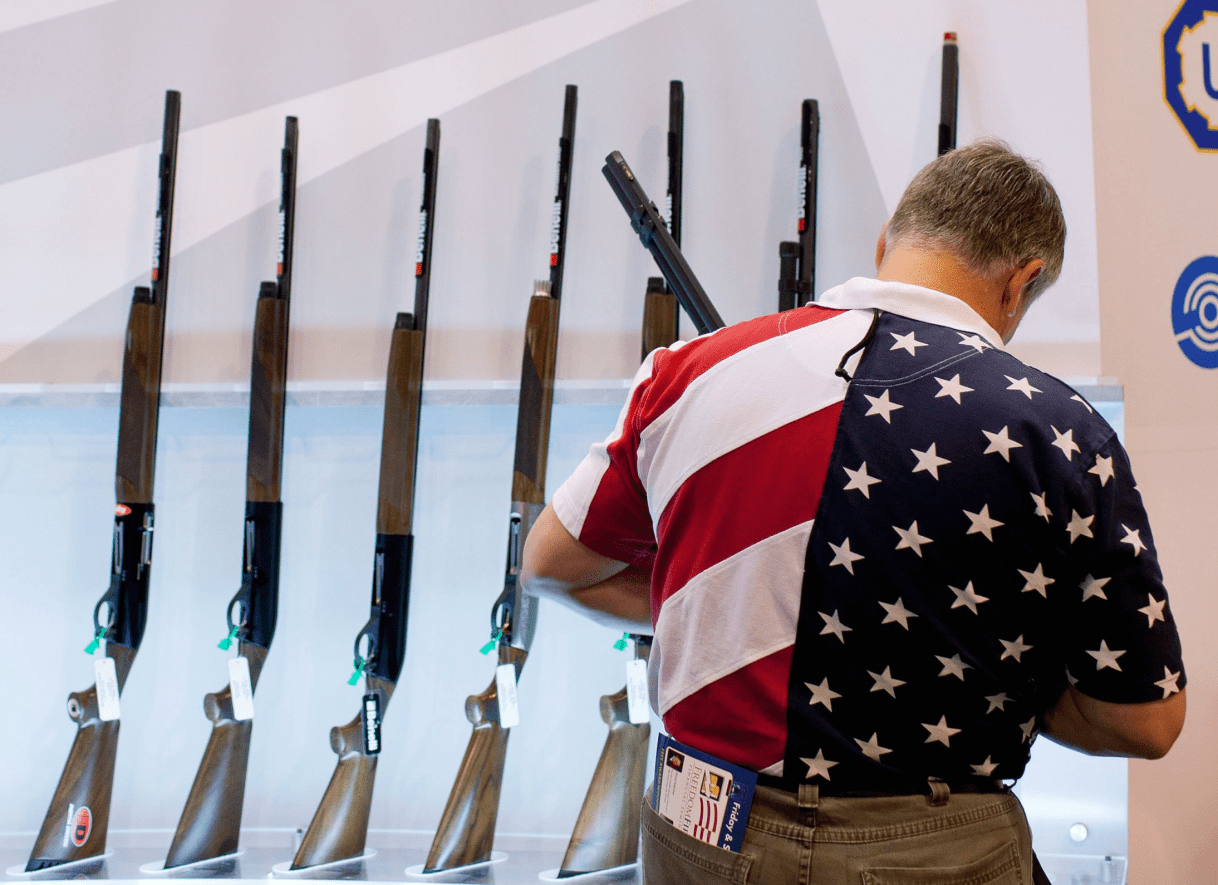
Americans are crazy about their guns. They often claim they need them for home security, which begs the question, how many enemies do they have? However, they rarely, if ever, go to home security trade shows and conventions. They go to gun trade shows and conventions, swap meets online purveyors private sellers, no background checks required. They love their guns.

What’s crazy is that after Sandy Hook, where 20 children and 6 teachers were killed in an elementary school, nothing changed, except that more guns have been sold in the past five years. It has become the new normal to massacre concertgoers, churchgoers, and kids going to school.

“Aren’t mass murderers crazy?” I asked.

“Nope, no matter what Agent Orange says,” said Barron Cannon. “It’s about one in five who are delusional or psychotic. Neither the Orlando nightclub shooter nor the Las Vegas killer had any apparent mental illnesses, unless you believe shooting people in and of itself is a mental illness. What they were was angry and disgruntled.”

“That’s not what the White House says,” I said.

“I know, but that’s what the Department of Justice says, which knows better than Agent Orange, who only knows blowhard bluster on Twitter. Most mass murderers are injustice collectors with gun collections. When you have a paranoid streak, that’s a personal problem. When you have a paranoid streak and a boatload of guns, then that becomes everybody’s problem. That’s what Agent Orange doesn’t want to talk about. ”

The NRA and gun enthusiasts are fond of saying guns don’t kill people, people kill people. They oppose regulations protecting American citizens from crazy malevolent gun violence. They never talk about Jayne Mansfield or Tylenol, since it would make everybody dizzy at NRA headquarters.

In 1967, when the Hollywood sexpot Jayne Mansfield rear-ended a tractor-trailer, ramming her car underneath it and dying as a result, the National Highway Traffic Safety Administration immediately made it mandatory for all semi- truck trailers to be fitted with under-ride bars. In 1982, when 7 people in Chicago died from poisoned Tylenol, federal anti-tampering laws were immediately put in place. Bottles of everything medical have been hellishly hard to open ever since.

Between 1968 and 2015 the total deaths caused by firearms in the United States were 1,516,863. Getting shot is an immediate experience, since bullets travel on average 1,7000 MPH. Since 1968 it has gotten easier, not harder, to buy all the bigger badder faster-blasting guns you want. The pace of writing common sense gun laws has stayed at ZERO MPH.

“When it comes to guns everyone’s got their reason, the 2nd Amendment, target shooting, recreation, whatever that means, hunting, and personal protection,” said Barron. “The NRA and Agent Orange gush about the 2nd Amendment as an argument against gun control, but almost no one cares about that.”

The Gallup Poll consistently shows that about 5% of people who own guns cite the amendment as their reason.

“Personal safety is the reason most people own a gun,” he said.

The Gallup Poll has always shown that protecting themselves has been, by a wide margin, the number one reason people buy guns.

Whenever there is a mass murder, like the recent mass murders in Las Vegas and Texas, support for stricter gun laws spikes. After a month-or-so, even though more than 80% of Americans consider gun violence a big problem, interest fades until the next mass murder. In the meantime, Congress and the White House do nothing, except mouth platitudes about their thoughts and prayers being with the dead the wounded and their families.

They never actually get off their NRA-bought-and-paid-for bottoms and buy into 21st century gun control. “It’s time for Congress to get off its ass and do something,” said Senator Chris Murphy of Connecticut. The chances of that happening are close to ZERO.

“Sometimes the notion that American society is inherently violent is floated as a reason there’s so much gun violence,” said Barron. ”Or it’s video games or racism or poverty. Conservative Christians say Satan is to blame. Agent Orange and Congress spearhead the notion that only crazy people are mass murderers. They propagate it being a nut case problem, not a gun problem.”

He looked down at his laptop and finished editing his Facebook post. When Barron Cannon has a great notion it’s best to wait him out.

“That’s all wrong,” he said. “It’s essentially about the astronomical number of guns in this country. That’s the problem. The other problem is that no wise man ever took a handgun to a gunfight. The times change and technology changes. You always take bigger and better ordinance.”

The more guns the more shooting.

“Yemen and Serbia have the next-highest rate of gun ownership in the world, next to the United States,” said Barron. “The United States has the highest rate of mass shootings in the world. It’s Boot Hill all over again, writ large.”

In the United States the homicide rate is 33 per million people, greater than any other developed country in the world. In Canada it is 0.7 per million. You are 50 times more likely to be shot and killed on the American side of Niagara Falls than you are on the Canadian side.

When the front door opened both Barron Cannon and I looked up. The tall young man stopped in the doorway, the late morning light silhouetting him. He had a Glock “Safe Action” Sig Sauer stuffed into the waistband of his black Levi’s.

Ohio is an open carry state.

“What can we do for you, partner?” asked Barron.

“Are you the outfit that’s doing the gun amnesty?”

“Sure are.”

“Well, this is what I’ve got for you,” said the lanky stranger. He pointed down at the bulge in his pants.

“I can’t shoot straight, anyways.” He tugged the gun out of his waistband and handed it butt first to Barron. “It’s not loaded.”

“That’s neighborly of you.”

“So I get 20 yoga classes for it?”

“That’s right,” said Barron. He flipped open his laptop. “Let’s get you signed up.”

Afterwards, after we had delivered the Glock to the Lakewood Police Department, during lunch at Melt Bar and Grill up the street, over a whiskey on ice in a lowball glass that I insisted Barron buy me to settle my nerves, I asked him if he thought his gun amnesty program would make any difference.

“There’s no energy in death,” he said. “There’s only life energy. If the White House and Congress won’t pull the trigger on gun control, then what we need is more breath control. That’s where yoga comes in. You can learn to be breathless without getting the breath knocked out of you by a bullet.”

Mao Zedong, the Communist Chinese dictator, was notorious for saying, “In order to get rid of the gun it is necessary to take up the gun.”

“He’s long gone,” said Barron. “Good riddance to bad rubbish. I say it’s necessary to take up yoga.”

“I’ll drink to that,” I said.

Ed Staskus posts on 147 Stanley Street http://www.147stanleystreet.com and Made in Cleveland http://www.clevelandohiodaybook.com. To get the site’s monthly feature in your in-box click on “Follow.”