
By Ed Staskus
“Mammy, you know how those men dug a hole in the ground for daddy because he wasn’t alive anymore?”
“Yes, Maggie, we buried his body in the ground but his soul lives with God.” Siobhan said after the funeral for her husband. He had been interred in the boneyard up the hill. She was in the kitchen preparing dinner.
“I saw daddy dig a hole behind the barn and bury something in it.”
“Is that the secret you wanted to tell me about?”
“Yes.”
“When did you see that?”
“I saw it when he came back.”
“Came back from where?”
“When he left with all the horses that time and came back. Do you think he buried something in the hole for God?”
Siobhan Foyle rubbed her hands clean on her apron. “Show me where that is,” she said. The widow and her daughter walked out of the kitchen, across the yard, and behind the barn. It was early evening, the sun arcing away from them.
“There, mammy, where the fox is digging, that’s by where daddy buried his treasure.”
A red fox was digging, stopping, listening, and digging again. The animal had long, thin legs, a lean lithe frame, and pointed nose. His tail was bushy. Foxes ate everything, rats, mice, voles, lizards, rabbits and hares, birds, fruits, and bugs. Those on the shoreline ate fish and crabs. There wasn’t anything that wasn’t grist for their mill.
“What is he doing?” Maggie asked, watching the fox watching and listening.
“When he stops to listen, he’s listening for a mouse or a rat underground,” Siobhan said.
The fox cocked his head. “I know you’re down there,” he announced to whatever was down there. “You can’t get away.” He dug deeper, not trying to be quiet. He knew he could dig faster than whatever rodent was soon going to be his breakfast could tunnel to safety.
The tod was the size of a medium-sized dog. His vixen was probably in the nesting chamber with their pups. They lived in the dunes, in burrows they dug for the family. There were always several ways of getting into and out of the den in the event predators snuck in trying to eat the pups. The tod and vixen stored grub there, pushing it under piles of leaves, spending most of the day in the safe and sound, searching for more food mostly at night.
The fox looked up. Siobhan knew they could see as well as cats, their vertically slit pupils glinting. If he yipped and turned to go, he would be gone in a flash. They were practically the fastest animals on the island. Many people thought they were cunning. Some people thought they had magical powers. Whatever spells they could cast never helped when a coyote was tracking them.
When the fox finally got his mouse, he trotted off with it. Siobhan went into the barn and brought back a shovel. Maggie pointed at the spot where to dig. Ten minutes later her mother had a dirty leather tobacco pouch in her hands. She knocked the loose dirt off it and walked to the house, Maggie trailing behind her. They sat on the porch facing Foyle’s Cove. When she opened the pouch and reached inside it, her hand brought out money in bundles held together by elastic bands. She had never seen elastic bands before and never seen that much money, either. When she finished counting it there was $7,000.00 in her lap.
It was all in fifty-dollar Dominion of Canada bills. The god Mercury was on the front holding a map of British North America, along with drawings of a harbor, ships, and a train in the background. “50 Dollars Payable at Montreal” was printed on the back. Montreal was where her husband had sold his horses.
“Somebody is coming,” Maggie said. A two-man horse and buggy was coming down the road, except there were three people in the buggy. There were a man and a woman and a one-year-old girl.
“It’s Clara and Hugh come down from Clifton with their new-born,” Siobhan said as the buggy got closer. The rest of her children were on the porch watching. She stuffed the cash money back into the leather pouch and handed it to Kieran Jr., her oldest son. “Go to my bedroom and wait for me there. Keep this in your hands and on your lap until I come for it.”
“Good day,” Siobhan said as the buggy came to a stop. Clara handed the child to her. Hugh walked around and helped his wife down to the ground. Lucy Maud Montgomery looked up at Siobhan and smiled. Siobhan smiled back. The baby girl cut cheese and Siobhan gave her back to her mother.
“Lucy is a lovely name, but she looks like an Annie to me,” Siobhan said.
“That’s odd, because you’re the second person who has said the same thing,” Clara said.
“We wanted to stop and pay our condolences,” Hugh said.
“Thank you,” Siobhan said.
“Kieran was a good man.”
“Yes, he was.”
Hugh fed and watered the horse. The grown-ups sat and talked on the porch. The children played with the baby. When the sun started to set Hugh and Clara got ready to go to North Rustico where they planned to spend the night with relations.
“Come and have dinner with us,” Clara said.
“I would love that,” Siobhan said and that is what she did, but not before walking upstairs to her bedroom with Kieran Jr. and Sean, her second-oldest son. “I won’t be back tonight,” she said to them. “Put the other children to bed once it gets dark. Don’t light anything. Keep this bag in this bed with you tight between the two of you until we decide what to do with it tomorrow.” She kissed her sons, and the other children downstairs, and once outside walked alongside the buggy towards town. She carried the baby, cooing at the child as they walked past the burying ground.
The next morning, she made breakfast for her children. When they were done eating, she and the girls cleaned up while the boys tended to their chores. Michael was too small to do much, but Kieran Jr. and Sean were strong boys who knew their way around animals and farmland. Next summer she would add on to the house, adding two bedrooms so when the boys and girls grew up, they could have separate bedrooms. She would improve the fields and fences. She would hire a farmhand, but not increase the size of her herd overmuch. Her husband had wanted to eventually keep a hundred horses, but she didn’t think the land would keep that many. She would devote three hundred acres to the horses and thought forty or fifty of them would be best.
She didn’t believe in continuous grazing. Horses had a bad habit of grazing their favorite grass close to the ground, then returning to eat the regrowth as soon as it came back. As the year went on there wasn’t enough of it left to capture sunlight. It had to use stored energy to regrow. If horses kept eating in the same place, energy stores ran out and the grass died.
Horses liked orchard grass, smooth brome, and timothy the best. They could eat it all day long down to the bare earth which was when weeds started to grow in their place. Siobhan had heard of rotational grazing and that was what she was going to do. She would move the horses to one pasture and let the other pastures recover. Each of the pastures would be left empty for at least several weeks at a time. That was how long it took for forage regrowth after grazing to happen.
She had four paddocks connected to a sacrifice lot. The lot had a shelter, a feeder, and a water source so that the paddocks didn’t need to have their own. The horses could get to the sacrifice lot anytime they wanted. They liked it that way. Siobhan was determined to keep draft horses. She wasn’t a racing horse woman. Prince Edward Island was a farming island and farmers needed draft horses more than anything else.
When Friday came and before it went, she told the children they would be going to Charlottetown the next day, and staying overnight, so they could buy clothes, shoes, boots, tools, small barrels, utensils, dishes, a new table and chairs, and as many household necessities as they could carry back. Winter would be upon them soon enough.
Her team could go at 15 KPH if they had to and get them to Charlottetown in two-and-a-half hours, or die trying. The road wasn’t especially rough or hilly, but it wasn’t smooth and flat, either. If the team plodded they could get to the city and live to tell the tale, although it would take them five hours-or-more. She would take the four youngest children with her and leave the two oldest behind. She stood Kieran Jr. and Sean on flattened brown paper and traced their bare feet for new shoes. She rolled the paper up and tied it with a string. She measured their arms and legs and height for new jackets and trousers.
The five of them going all together would weigh less than 400 pounds. They would be markedly heavier coming back, but the horses could pull ten times and more that weight with no trouble and do it all day if the going was slow and steady. She hitched the horses to their farm wagon and started before dawn. Maggie and Michael, the two youngest, sat up front with her. Biddy and Kate knelt in the back on the floor of the wagon leaning on the tailgate, looking back at the way they were leaving behind.
When coming into Charlottetown she asked the children if they wanted to see Fanningbank. “Yes, please!” They were unanimous that they wanted to see it. “Our teacher told us it is the Government House,” Biddy said when she saw it. “Why do you call it Fanningbank?”
“It’s because a hundred years ago Edmund Fanning, who was going to become the governor, set this land on the riverbank aside for the building of a residence for the governor,” Siobhan said. “The land was his and known as Fanning Bank then, and that is what it has stayed to this day.”
Fanningbank was a large Georgian style house. It was the kind of architecture popular in England in the 18th and early 19th centuries. The Georgian style valued classical balance. John Harvey was the second governor to live there. After the start of the new year of 1837, in the dead of winter, he held the first dress-up party in the elegant house.
“An entertainment upon a splendid scale was given by Sir John and Lady Harvey at Government House on Thursday evening last,” the Royal Gazette reported. “As this was the first occasion the rooms were thrown open to a large evening party, no pains were spared to give full effect. At ten o’clock dancing commenced, which was continued with great spirit and animation until after one o’clock. The rooms were brilliantly lighted, and this, added to the crown of beauty and fashion with which they were thronged, exhibited their handsome proportions and striking appearance to peculiar advantage.”
The dancing, mingling, gossiping, and back-slapping took place in the Grand Ballroom, a high-ceilinged room surrounded by eight columns. When the party was over His Excellency and Lady went upstairs and rooted around under the covers in the Sovereign’s Bedroom. The party was the talk of the season that year. When the baby was born in September he was told all about the party.
In 1864 the delegates to the Charlottetown Conference came to the house in the evening for an official dinner and dance given by Governor George Dundas. They had a grand time excited by their grand plans, although none of them had any illusions about what it would take to make their plans come true.
“Mammy, why do they call them excellencies?” Maggie asked. “Are they better than us?”
“I will tell you when you are a little bit older,” Siobhan said.
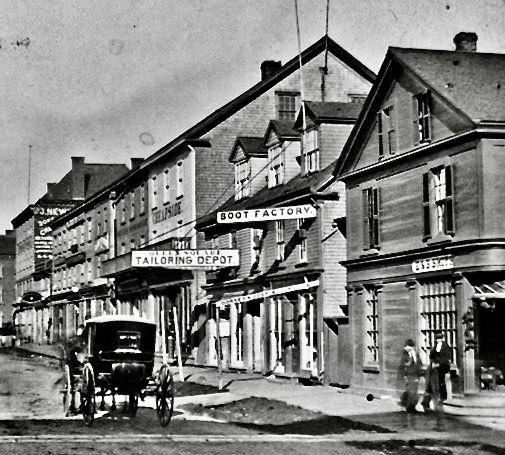
They went on to the south side of Queen Square, one of Charlottetown’s main commercial streets. It was where Siobhan knew there was tailoring, the selling of dry goods, and the manufacture and sale of rubber boots and furniture. What she didn’t know was that a fire had swept through the section destroying all but one building on the corner of Richmond and Queen. Where wood had stood brick was being laid, but nothing was ready yet to provide her with what she wanted and needed.
Charlottetown was a small city but with big enough business, and she had no great difficulty finding the clothes and goods she was looking for elsewhere. One merchant’s loss was another merchant’s gain. The first merchant she visited was the shoemaker Thomas Strangman and Sons. A shoe stitching machine had been invented by an American in 1856. It was known as the McKay Stitching Machine and Thomas Strangman was the first man on Prince Edward Island to have one. Sole cuts tailored to fit the right or left foot were still on the way. In the meantime, it was make them shape up on your own.
When she was ready to pay for the shoes and boots for her children and herself, she showed one of the fifty-dollar bills to Tom Strangman.
“Is my money good here?”
He looked at the front and back of the bill.
“Yes, ma’am, your money is good here.” He would take it next door to the dry goods store, which was also an exchange bank, among other things.
She bought rice, sugar, and coffee. She bought cotton socks, wool socks, undershirts, under garments, shirts, denim pants, and blankets. She bought rolls of calico, brown shirting, domestic gingham, and bleached cotton. She bought a heavy plaid shawl for $3.00. She bought a dining room table and eight chairs for $45.00.
On the way back to Foyle’s Cove the following Sunday morning the children sat on the chairs at the table in the back of the farm wagon all the way home, waving to everybody they saw, pointing out a cross-eyed cow, another cow who brayed like a crow, and singing songs. They took turns sitting at the head of the table. They sang parlor songs and minstrel songs. They sang “The Maple Leaf Forever” and “The Red River Valley.” They sang loud and off-key.
They sang a sad song. “From this valley they say you are going, I shall miss your bright eyes and sweet smile, for alas you take with the sunshine, that has brightened my pathway awhile.” Siobhan kept her eyes fixed on the track ahead of her while her children sang. She let her horses find their own way.
Photograph: Charlottetown, PEI, in the 1870s.
Excerpted from “Ebb Tide.”
Ed Staskus posts stories on 147 Stanley Street http://www.147stanleystreet.com and Cleveland Ohio Daybook http://www.clevelandohiodaybook.com. To get the site’s monthly feature in your in-box click on “Follow.”
“Ebb Tide” by Ed Staskus
“A thriller in the Maritimes, out of the past, a double cross, and a fight to the finish.” Sam Winchell, Beyond Books
Available at Amazon: https://www.amazon.com/dp/B0CV9MRG55
Summer, 1989. A small town on Prince Edward Island. Mob money on the move gone missing. Two hired guns from Montreal. A constable working the back roads stands in the way.
A Crying of Lot 49 Publication

 147 Stanley Street