
By Ed Staskus
The morning after my first night waiting tables at the New York Spaghetti House I got a call from the assistant manager to not come back. He was loud and clear about what he meant to say. He said, “Don’t come back.” I told him I understood. I couldn’t have done a worse job. It would have been better for all concerned if I hadn’t shown up at all. I was surprised when he called me back in the middle of the afternoon and asked me to come back. He was again clear about why I was being asked to return.
“I am not able to find anybody else,” he said.
When I went back that night I was demoted from waiter to busboy and one of the experienced busboys was promoted to waiter. I had told them I was experienced at waiting tables, which was a gross exaggeration. I had once waited tables for a month at a greasy spoon near Chinatown where all I had to do was pour coffee and shuffle plates of breakfast and burgers back and forth. My first night had proven how thin my qualifications were.
I worked at the New York Spaghetti House for nearly two weeks in the late 1970s because one waiter had gone to Las Vegas for a daughter’s wedding, where he stayed for another week when he got on a winning streak, one was helping his mother move into a rest home, and another was coughing his head off with the flu. The restaurant was all of a sudden short-handed. They had to take desperate measures, which was the only reason I was there. I was neighbors with one of the waiters. He was an older man, divorced, and lived in North Collinwood, like me. He had put the good word in about me. They paid me in cash, which I was good with.
The New York Spaghetti House opened in 1927 in downtown Cleveland. Before it became a restaurant the building, built in 1870, had been the parsonage of the Zion Lutheran Church. After it wasn’t a parsonage anymore, sometime around 1900, a vaudeville promoter housed his actors there. The restaurant was opened by Mario and Maria Brigotti, who came from New York City, where Mario had worked as a waiter in several basement spaghetti houses. When they opened on E. 9th St. the neighborhood around them was overflowing with Greeks and Turks. They went to the New York Spaghetti House for Turkish coffee and hookahs.
The Brigotti’s served fresh warm bread and large bowls of pasta with a spicy brown sauce. The sauce was made from a vegetable and plum tomato base, finely ground up beef, and a secret blend of spices. The brown sauce made their name in the city. It’s not how you write your name, it’s the ink in the pen that matters.
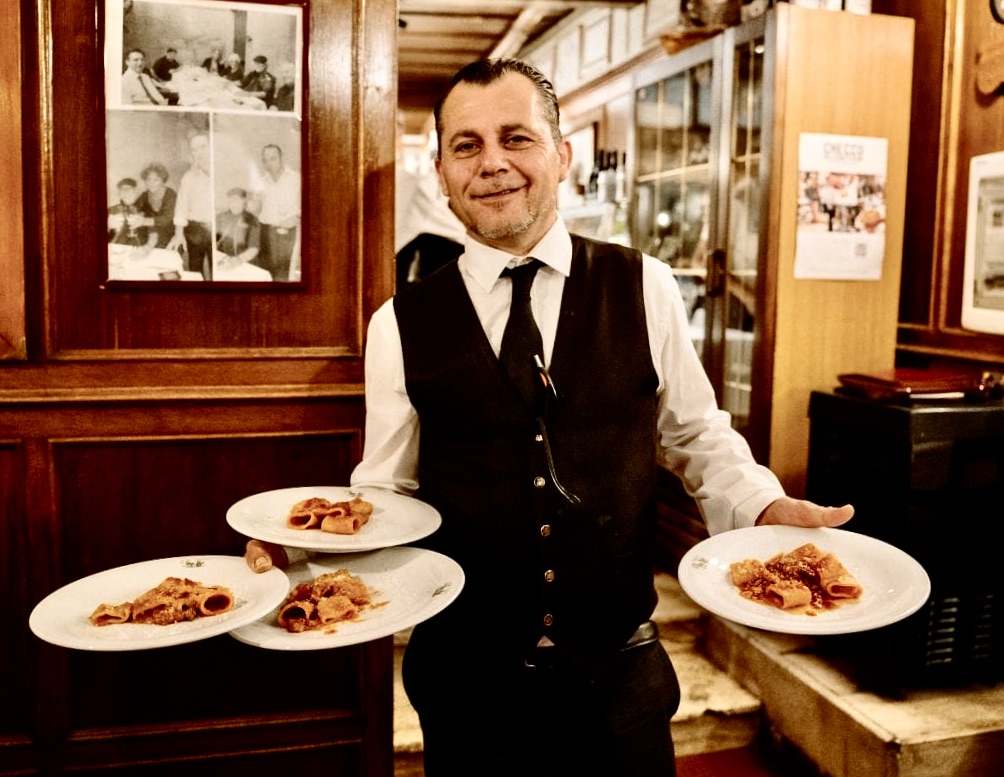
The waiters at the New York Spaghetti House were all men, middle-aged and older. They carried themselves with poker faces, as though on military parade. The busboys were younger. I was one of the youngest busboys during my tenure there, even though I was in my late 20s. The waiters wore black pants, black shoes, and black ties. Some of them wore black vests. Their shirts were white. They took orders by memory, never writing anything down. That turned out to be my downfall. My memory played tricks on me all night long my first night there. The kitchen crew got sick and tired of replacing my mistakes.
Once I got the hang of busing tables I didn’t mind it. At least I didn’t have to memorize anything. Bussing meant removing soiled plates, glasses, silverware, and napkins from tables, setting tables for new feeders with clean plates, glasses, silverware, and napkins, refilling drinks and delivering food if servers were busy, as well as keeping the dining room tidy, mopping up spills, and staying out of the way of the head waiter. He was a stern man and didn’t suffer fools among the workforce, although he was unfailingly polite to diners.
One evening a woman with Shaker Heights written all over her asked him if the cream in her coffee was fresh. “Yes, it is fresh,” he said. “This morning it was still grass.”
“Oh, I’m so glad,” she said. The head waiter flashed a thin smile.
The tablecloths were red and white checkered. Bussing tables meant always being at hand, even though there wasn’t always anything to do. In between staying busy I listened in on the goings on at nearby tables. It was like going to the movies. There were first dates and wedding anniversaries. There were birthdays, graduations, and family reunions. There was plenty of gossip to be overheard, there being plenty of lawyers, bankers, and politicians downtown.
I listened in on a pair of yuppies. I worked out that they were both lawyers. I couldn’t work out the whys and wherefores behind their dinner date. They were a good-looking couple but sparred with mean-spirited conversation all through the appetizer, soup, and the principal meal. When they were done chewing their food they kept on chewing on each other.
“You shouldn’t drink so much,” she said. “You’ve got be at work bright and early.”
“Like they say, work is the curse of the drinking class,” he said.
“You should know.”
He got steamed up and looked like he was going to jump down his own throat, but instead poured some more booze down it.
When vaudeville houses downtown were going strong in the 1920s performers like Jimmy Durante and W. C. Fields ate at the New York Spaghetti House all the time. After World War Two Mario’s brother Marino came from Rome to help out and stayed, eventually becoming the head chef. He was the boss of the kitchen during my short stint there. After my first day I avoided him, the same as I avoided the head waiter. I didn’t have a problem with authority, so long as it ignored me.
The dining tables were draped with red-and-white-checked tablecloths and the walls were wood paneled, except where they were covered by murals. The murals were painted by John Cgosz, an expatriate Hungarian painter. They depicted gondoliers in Venice, the harbor at Naples, the Coliseum in Rome, and the island of Capri. The island was intensely sunlit in the dimly lit dining room. It was like a tour of Italy.
Every so often somebody or other came in alone and ate alone, He was almost always a man. The life in his eyes was usually the color of something he’d forgotten. He drank Chianti while waiting for his spaghetti. He slurped coffee after dinner and never left much of a tip. He always looked the way somebody looks when he doesn’t know anybody at a party.
One night a couple came in with twin six year olds. Children eating at the New York Spaghetti House weren’t entirely unusual, but it was uncommon. The twin girl started acting up during dinner and wouldn’t stop. Her brother soon joined her. Diners at two tables asked to be moved downstairs. The head waiter finally made an appearance and explained the children were being disruptive and they would have to leave. The father of the children, however, wasn’t prepared to leave his half-eaten dinner behind. He frog-marched his twins outside and came back alone a minute later. When the head waiter raised his eyebrows the man said, “I locked them up in the car.”
The front of the restaurant was chalet-style, like something from the old country. Inside it was bigger than it looked from the sidewalk. It was six thousand square feet big, which was nearly two thousand square feet bigger than an NBA basketball court. There was a long oak bar in the lounge. There was a floating staircase. The kitchen was small. The station chefs, sous chefs, and head chef were always cursing in Italian in the infernal heat.
On a mid-week night a man and woman walked in. “They have great spaghetti here,” the man said as they entered. They had gotten married over the weekend and were still celebrating. They were seated on the main floor and ordered a bottle of red wine and matching spaghetti plates with meatballs on the side. Shortly after being served dinner their waiter came over and said to the wife as politely as he could, “We do not cut our spaghetti here.” Long spaghetti is designed to be twirled around a fork. It ensures a better distribution of sauce. The brown sauce at the New York Spaghetti House was their measure of craftsmanship. Cutting the spaghetti made it harder to twirl and reduced the lengthy surface for the brown sauce. It altered the aesthetic.
The wife looked up at the waiter and said, ‘I’m from Baltimore and we cut our spaghetti there.” She didn’t put her knife down. The waiter didn’t want to insult Baltimore and so he didn’t say any more. The waiters could be stiff-necked but knew when to be discrete.
I got acquainted with the other busboys, since we were all in the same boat. One of them, whose name was Enzo, was my age and we got along fine, until he was sent home and I didn’t see him after that. What happened occurred on a Sunday night. It wasn’t especially busy. Enzo and I were busy doing nothing when a young man strode across the main dining room right at us. He was wearing a gray t-shirt, black pants, and a scowl on his face. His hair was black, slicked back, and his skin was olive. He was Italian like Enzo.
When he got to us he ignored me and got into Enzo’s face. He was speaking in Italian. I didn’t understand a word of it, although I could tell he was angry. Before I knew it he grabbed Enzo’s shirt collar, twisted it, and pushed him hard against the wall. Enzo was pinned. He pulled the ears of the young man but to no effect, so he head butted him. Blood gushed from the young man’s forehead. He punched Enzo and broke his nose, but before anything else could happen a scrum of waiters and busboys broke it up. They dragged the young man out the back door and threw him into the alley.
When they came back Enzo was sitting in a corner with his head thrown back and ice on his nose. There was blood all over his white shirt. I asked one of the waiters what it had all been about.
“Enzo steal his girl,” the waiter said.
A man in a dark suit and an angel face in a low cut dress were one of the last tables my last night. Thankfully, nothing had gone wrong that night, although closing time was still an hour away. The man was smoking a cigar. He looked like a gangster. After dinner he ordered decaf coffee for himself. The angel face was inspecting herself in a hand mirror. She didn’t order anything. The waiter was busy and asked me to serve the coffee. “Make sure it’s decaf, pal,” the man said. “If I’m still awake at three in the morning, I’m going to call you to complain.” I didn’t like his sense of humor, if that’s what it was. It was the end of my job of work at the restaurant and I decided one more mistake wasn’t going to kill me. I brought him straight-up coffee. I wasn’t worried about him calling me. He didn’t have my phone number, which was a good thing. I found out later he didn’t just look like a wise guy. He was a wise guy up the hill in Little Italy.
I collected my pay, had dinner on the house, and went home. It was the last time I set foot in the New York Spaghetti House. After I got married and thought about going for dinner sometime, it had closed and moved to the suburbs. My wife and I didn’t drive out there because the suburbs are more flavorless than not.
One day the next summer I was standing outside of Captain Frank’s on the E. 9th St. pier when a man in a dark suit approached the front door. He looked like the Mob. Another man in a dark suit, younger and bigger, held the front door open for him. He looked like Mob muscle. Captain Frank’s was a seafood house. Cleveland’s underworld ate there day in and day out. I had gone for a long walk along the lakeshore to the Cleveland Public Power plant and back and was waiting for a friend of mine to pick me up.
“Hey, don’t I know you from somewhere?” the Mob man said, pausing inside the doorway. ”Aren’t you a waiter here?”
“No, sir, I don’t work here.” I didn’t say anything about the New York Spaghetti House.
“I swear I remember you from somewhere and it’s a sour memory.”
Oh, oh, spaghetti-o’s. “I’m new in town,” I said. “I just got here, so it couldn’t have been me.”
“All right,” he said and made his way into Captain Frank’s.
I walked to the landward side of the pier and leaned on a telephone pole, waiting for my friend. Whitecaps were breaking over the pier. Lake Erie is shallow, long, and narrow. The fetch makes waves grow taller and break forcefully. I knew full well there were no sharks in the water, but I kept my eyes open for any more unpleasant surprises.
A version of this story was published in the ezine Spillwords.
Ed Staskus posts monthly on 147 Stanley Street http://www.147stanleystreet.com, Made in Cleveland http://www.clevelandohiodaybook.com, Down East http://www.redroadpei.com, and Lithuanian Journal http://www.lithuanianjournal.com. To get the site’s monthly feature in your in-box click on “Follow.”
“Cross Walk” by Ed Staskus
“A Cold War thriller that captures the vibe of mid-century NYC.” Sam Winchell, Beyond Books
Late summer, New York City, 1956. The Mob on the make and the streets full of menace. President Eisenhower on his way to Brooklyn for the opening game of the World Series. A killer waits in the wings. Stan Riddman, a private eye working out of Hell’s Kitchen, scares up the shadows looking for a straight answer.
Available on Amazon: https://www.amazon.com/dp/B0CRPSFPKP
A Crying of Lot 49 Publication
 147 Stanley Street
Enjoyable, entertaining read. Expected Martin Scorsese to make an appearance.
LikeLike