
By Ed Staskus
On Monday morning the weather was good, in the high 50s, with no rain predicted the rest of the week anywhere east of the Mississippi River. It was the first of October. In two weeks to the day, it would be Dwight Eisenhower’s birthday. In six weeks to the day, it would be Mamie Eisenhower’s birthday. The presidential election was coming up fast. “We Like Ike” was the word of the day.
By the time the sun was up Dwight and Mamie Eisenhower had been awake more than two hours. They arrived at the Terminal Station in Cleveland, Ohio, riding a 12-car campaign train on an overnight run from Washington. The Terminal Tower’s office building foundations were 250 feet deep. More than a thousand ramshackle buildings had been demolished making space for it in 1924. When the ribbon was cut in 1927 it was the tallest building in the world outside of New York City. The first Nickel Plate Railroad train pulled into the station two years later to hurrahs.
The station was in the prime of its life, but Dwight Eisenhower was putting intercity train travel and Cleveland’s Terminal Station, and all of its kind, slowly but surely out of business by federally subsidizing a network of interstate highways. “Neither a wise man nor a brave man lies down on the tracks of history to wait for the train of the future to run over him,” the president explained, without a doubt in his mind about the right-of-way of his road project. It had been in the back of his mind since the Louisiana Maneuvers in 1941. It was after his United States Army trucks got stuck all over the place because of the country’s bad roads that he said to himself, “We need better roads.”
The Soldiers and Sailors Monument on Public Square, across the street from the Terminal Tower, glistened in the early autumn sun. The fire department had spray cleaned the monument over the weekend, showering it with hundreds of gallons of white vinegar, and then hosing off the bird droppings and grime. The hometown vermin didn’t appreciate it, but what could they do? They didn’t pay taxes or vote and so they didn’t count.
The monument was built thirty years after the Civil War, a 125-foot granite shaft on top of a square base housing a memorial hall, larger than life bronzes lining the outside, and marble tablets inside with all the names of the more than nine thousand Union soldiers from Cuyahoga County, the county in which the city lay, who didn’t come back from the war with Johnny Reb. Most of them stayed where they fell.
“Good morning, Mr. President,” said Robert Bridle, manager of the Hotel Cleveland. “Good morning, Mr. Mayor,” he said again, turning to Anthony Celebrezze, the city’s mayor. The manager’s mouth puckered like a kiss when he said “morning.” The Hotel Cleveland was shaped like an “E” opening onto Superior Avenue. The one thousand rooms were built in 1918 by the Van Sweringen brothers, who built the Terminal Station ten years later.
Anthony Celebrezze was a Democrat, mayor of the fifth-largest city in the United States. He knew how to get things done. Dwight Eisenhower, a Republican, meant the keys to the federal purse-strings to him. He was going to try to loosen those strings. He knew it was a fight to the finish with every other city in the country. He knew how to roll with the punches if he had to.
The mayor’s father had been a shepherd in Italy, and then a track laborer on the Wheeling and Lake Erie after he emigrated to the United States. Tony Celebrezze put himself through John Carroll College by working as a truck driver and a boxer, beating the other’s guy’s brains out for peanuts in bitter undercards. The peanuts paid his school tuition.
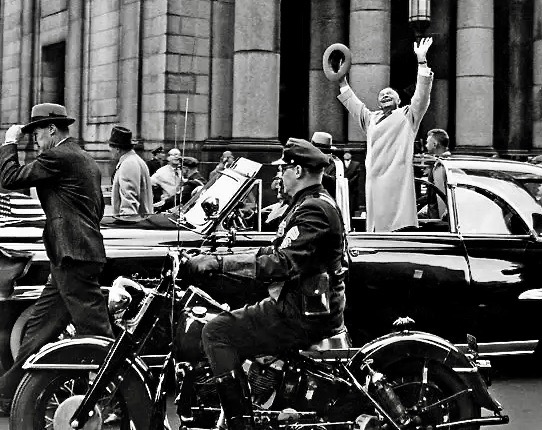
Dwight Eisenhower was giving a speech in the hotel to the faithful that day, taking a short break, and then giving another speech in front of Higbee’s beside the monument to friends, enemies, and the lunch crowd. Downtown Cleveland was spic and span. The commander-in-chief liked what he saw. The dummies in the window of a clothes shop on Euclid Avenue came to life and waved when he and Mamie passed by. He tipped his hat to them, smiling his trademark smile. He liked the mime.
It was noon on the dot when he greeted more than nine hundred invited guests to the Sales Executive Group Luncheon in the Main Ballroom. He spoke briefly, shook hands with every extended hand, walked out of the hotel, and threw at look at the Soldiers and Sailors Monument. He strode up some stairs to the speaker’s platform. He was giving his second speech of the day at twelve-thirty.
He was in the middle of two months of pressing the flesh, kissing babies, and giving the same stump speech day after day. His mouth had gone dry as a bone, and his palms had gone chapped. Flecks of baby spit littered his suits. He often had to rub somebody’s dandruff out of his eyes. It had gotten so he could tell the state anybody lived in by their body odor. When he looked, a dozen black and white Cleveland Police cars blocked off Euclid Avenue, Ontario Street, and every other street in sight.
The rats Bert, Mert, and Luke scampered out of the Memorial Room of the monument to its roof, stopping at the base of the polished black stone column. They could have climbed to the top of the column, one hundred and twenty-five feet to the top, wending up the six foliated bronze bands listing the names of the thirty battles in which soldiers from Cuyahoga County fought, if they wanted to. Their eyesight wasn’t the best, not like their sense of smell, but their perch today was more than view enough, so they stayed where they were.
Since it was only a month to the election, Dwight Eisenhower got right to the point. “The opposition say that they alone truly care for the working men and women of America, and that Republicanism is a vague kind of political conspiracy by big business to destroy organized labor and bring hunger and torment to every worker in America,” he said to the overflow crowd.
“That’s right!” a loudmouth yelled from the front of the crowd. “The working man ain’t got a chance.” A Secret Service agent made his way through the crowd and stopped behind the man, watching his hands.
Secret Service agents watched from the roofs of the May Company and Higbee’s, and from inside the twin steeples of the Old Stone Church. The Berea sandstone of the church had long since turned black from pollution wafting up from the Flats, the nearby industrial valley that sprawled along both banks of the Cuyahoga River. The sun twinkled on the terra cotta façade of the May Company. The faces of shoppers were pressed against the upper story windows of the department store, watching the soapbox serenade below them.
The pastor of the church across the square sat in a lawn chair outside his front doors, his sleeves rolled up, warm in the warm October day. He had a ploughman’s sandwich, cheese and pickles, wrapped in wax paper in his lap. He unwrapped his sandwich. He took a bite and chewed methodically. The sky over Public Square was dappled with small clouds. He stretched his legs out. His father had been the pastor once. He grew up in the Presbyterian church. He served on all the church committees, was a volunteer at all the events, and made all the hospital and home care visits. Thank God for Dwight Eisenhower, he thought, basking on a rare day off.
Bert and Mert were Tremont twins. Luke was an orphan. He didn’t know where he came from. All his friends called him Eaka Mouse, even though he was a rat. The three friends usually slept during the day and foraged at night, avoiding owls, but this was a special occasion. They had never seen the top dog of the Grand Old Party up close. The birds were staying away because of the hullaballoo, but the rodents couldn’t contain their curiosity.
“This is more than political bunk,” Dwight Eisenhower declared. “Those men are fretting fear and worried doubt. It is wicked nonsense. We have given to our nation the kind of government that is living witness to a basic virtue in a democracy, public morality, public service, and public trust. There is no special favoritism, cronyism, or laxity in our administration.”
“That’s what they all say, “somebody bellowed from the middle of the crowd. Another Secret Service agent drifted his way.
Luke had the best sense of smell of the three of them. He led the way when they went searching for food, which was fifteen and twenty times a day. Their favorite foods were seeds and grains, which made the monument an all-day dream diner for rats. It was visited by hundreds, sometimes thousands of people, many of whom left behind crumbs of whatever they were snacking on. The pickings today were going to be out of this world.
In the wild the rats were vegetarians, but city life was different. They ate almost anything they could get. None of them liked cheese, though. No rat they knew liked cheese. They laughed at the traps filled with shavings of it. They weren’t looney tunes. They could smell the hand of man on carefully prepared bait cheese and knew to beware well enough.
“The men of the opposition know perfectly well that one of the main reasons they were thrown out of office four years ago was their tolerance of the fire of inflation,” Dwight Eisenhower said. “Just in the final seven years of their tenure of office this economic fever had cut the value of the dollar by almost one-third, damaging the livelihood of the aged, the pensioned, and all salaried workers.”
“What about the Bonus Army?” an old voice at the back called out. “Whadda ya got to say about that?” The Secret Service ignored the elderly man shaking his cane in the air.
Luke had recently chewed up a front page of the Cleveland Press for bedding. He noticed a feature article about last month’s government index showing living costs had shot up to a record high. “The cost of living has been remarkably stabilized,” Dwight Eisenhower in his everyman’s brown suit earnestly proclaimed, “During the previous Democratic administration, the cost-of-living increase was twenty times as great.”
Mert gave Bert and Luke the high sign. The rats had heard the grift and swindle of the campaign trail before. Shills came to Public Square all the time to spread their lies. The speechifying was making them sleepy. It was a lot of cutting corners and trying to corner the other guy. The three rodents stretched, groomed themselves briefly, curled up together, and were soon napping.
Dwight Eisenhower wrapped up his speech, stepped down from the platform, and was in his limo in his motorcade on its way to Cleveland Hopkins Airport by one o’clock. He and Mamie boarded the Columbine and were airborne to Lexington, Kentucky by one-thirty. In two days, at about the same time of day, he would be tossing out the first pitch of the 1956 World Series at Ebbets Field instead of tossing out half-truths. There wasn’t much fresh air in New York City, but he would enjoy what he could get.
The rodents ate most everything edible but avoided ice cream. They loved Canadian bacon more than anything. Most days, except Sundays, as long as the weather was good, they looked forward to the nut lady, the woman who looked more-or-less like Doris Day and Mammy Two Shoes rolled up in one. She was a middle-aged Slovenian woman with dark skin, dark hair, and dark eyes, She worked across the street from the square, at Morrow’s Nut House, near the revolving doors of the May Company. She brought them bits of bacon mixed with nuts when they took their mid-day break on the steps of the monument.
The nut lady worked behind the display case at Morrow’s, selling warm and lightly salted cashews and redskin peanuts, Spanish peanuts, almonds, hazelnuts, pecans, and oily rich walnuts. Morrow’s Nut House was on the corner, on the intersection, behind a CTS bus stop where passengers lingered while waiting for their ride. The shop pumped the smell of roasting nuts out onto the sidewalk all day long.
Bert, Mert, and Luke weren’t waiting for her today. There was a horn of plenty waiting for them on all sides of the Sailors and Soldiers Monument. Who said the Republican Party never did anything for the little man? They were ready to like Ike at a minute’s notice. But they had better things to do with their time. They were their own men. The three rats had girlfriends, Mary, Suzy, and Perla, waiting in the wings, ready to make nice.
The faithful and the feckless dispersed when the talking was over. The lunch time office workers went back to work. The shoppers went back to the stores. The loafers went back to loafing. Only the loafers knew the country had the best politicians money could buy. They knew the only difference between the political parties was that Republicans excelled at raking in the greenbacks.
“Hey guys, let’s shake it up,” Bert squeaked. “It’s time for the submarine races.” Eaka Mouse knew exactly what Bert meant. It was juice it up and hanky-panky time. They weren’t three blind mice, not now or ever.
“Come on, snake, let’s rattle.”
Excerpted from the crime novel “Cross Walk.”
Ed Staskus posts on 147 Stanley Street http://www.147stanleystreet.com and Made in Cleveland http://www.clevelandohiodaybook.com. To get the site’s monthly feature in your in-box click on “Follow.”
 147 Stanley Street